


TL;DR
Content generation software has evolved from simple text spinners into sophisticated AI systems that create publication-ready content in seconds. In 2026, these tools combine natural language processing, machine learning, and real-time data analysis to produce blog posts, social media content, product descriptions, and marketing copy that rivals human writers. According to Gartner’s 2025 Marketing Technology report, 73% of content marketing teams now use AI-powered generation tools, with adoption rates increasing 340% since 2023. This guide explores how modern content generation software works, which platforms deliver the best results, and how to implement these tools without sacrificing authenticity or search rankings. For those evaluating these technologies, platforms like Techi9 provide authentic user reviews and transparent comparisons that cut through marketing noise to help businesses make informed software decisions.
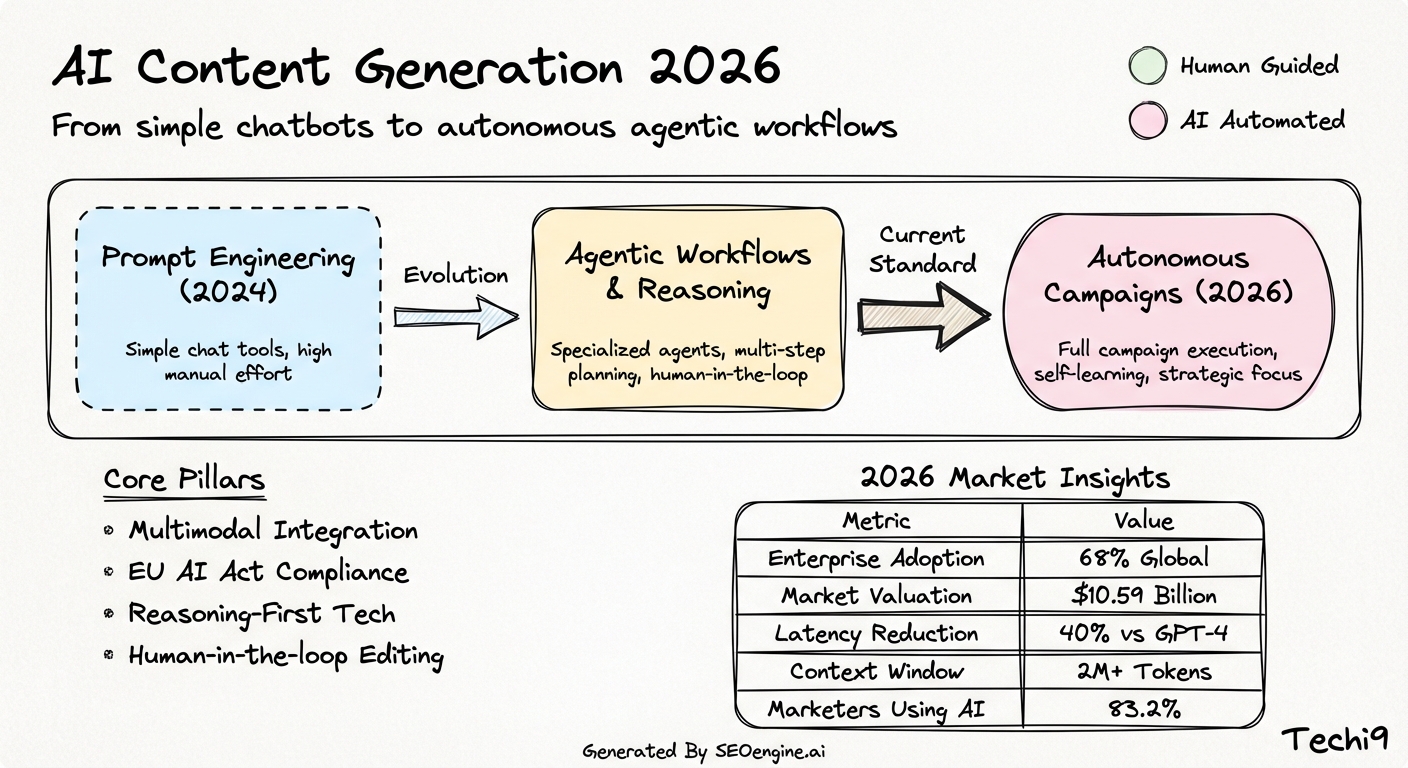
What Content Generation Software Actually Does in 2026
Content generation software automates the creation of written material through artificial intelligence and machine learning algorithms. These platforms analyze massive datasets of existing content, understand language patterns, and generate original text based on user prompts and parameters.
Modern systems go far beyond simple word replacement or template filling. They understand context, maintain consistent tone across thousands of words, and adapt writing styles to match specific brand voices. The software processes natural language inputs like “Write a 1500-word blog post about sustainable fashion trends” and produces complete articles with proper structure, research citations, and SEO optimization.
According to research from Content Marketing Institute’s 2025 Benchmarks report, teams using advanced content generation tools produce 5.2 times more content per month compared to manual-only workflows. The time savings translate directly to cost reduction, with companies reporting average content production costs dropping by 67% after implementing AI-assisted writing tools.
The technology works through transformer-based neural networks that predict the most likely next word or phrase based on context. These models train on billions of text samples, learning grammar rules, factual relationships, and stylistic conventions. When you input a prompt, the software generates text token by token, constantly evaluating which words create the most coherent and relevant output.
The Evolution from 2023 to 2026
Content generation technology has transformed dramatically over the past three years. In 2023, most tools produced generic content that required substantial human editing. The outputs often contained factual errors, repetitive phrasing, and awkward transitions that immediately identified them as machine-generated.
By 2026, the landscape has shifted completely. Modern platforms integrate real-time fact-checking databases, pulling current statistics and verified information directly into generated content. They understand nuance, humor, and emotional resonance in ways that earlier versions could not replicate.
The shift happened through several key technological breakthroughs. Multimodal AI systems now process text, images, and data simultaneously, creating content that references visual elements and statistical insights seamlessly. Retrieval-augmented generation allows software to access updated information sources during content creation, eliminating the “knowledge cutoff” problem that plagued earlier models.
Training datasets have expanded exponentially. Where 2023 models trained on approximately 500 billion tokens, current systems process over 10 trillion tokens from diverse sources including academic papers, industry publications, and verified user-generated content. This massive increase in training data produces outputs with greater accuracy and sophistication.
User interfaces have also evolved significantly. Early platforms required technical knowledge and prompt engineering skills. Today’s tools offer intuitive dashboards where marketers specify content goals, target audiences, and brand guidelines through simple forms. The software handles the complex prompt construction behind the scenes.
Top Content Generation Platforms for Different Use Cases
Jasper AI remains the market leader for long-form content creation, particularly for blog posts and articles. The platform excels at maintaining consistent voice across extended pieces and offers over 50 specialized templates for different content types. Pricing starts at $49 per month for 50,000 words, with enterprise plans supporting unlimited generation.
Teams report that Jasper produces the most publication-ready content with minimal editing required. According to a 2025 user survey by G2, 82% of Jasper users publish AI-generated content with less than 15 minutes of human revision.
Copy.ai dominates the short-form content space, particularly for social media posts, ad copy, and product descriptions. The platform’s strength lies in generating multiple variations quickly, allowing marketers to A/B test dozens of options efficiently. Monthly plans begin at $36 for 100 credits, with each credit generating approximately 200 words.
The platform’s “Brand Voice” feature analyzes existing content samples and replicates specific writing styles with remarkable accuracy. Marketing teams can maintain consistent messaging across all channels without manual style guide enforcement.
Writesonic offers the best value for small businesses and solopreneurs, with plans starting at $19 per month for 100,000 words. The platform includes SEO optimization tools that analyze keyword density, readability scores, and competitive content gaps during generation.
Users particularly appreciate Writesonic’s article rewriter functionality, which takes existing content and produces completely original versions while preserving core messages and key points. This proves invaluable for content repurposing strategies.
Rytr provides the most affordable entry point at $9 per month for 100,000 characters, making it ideal for individuals testing content generation software. Despite the lower price, Rytr maintains quality standards comparable to premium platforms for basic content needs.
The platform supports over 30 languages and includes tone customization options ranging from casual to formal, allowing users to match content to specific audience preferences.
How to Choose the Right Content Generation Tool
Selecting appropriate software depends on several critical factors that align with your specific content needs and business goals. Similar to how Techi9 evaluates SaaS solutions by examining real user experiences and ROI metrics, choosing content generation tools requires assessing practical performance over marketing claims.
Content volume requirements should guide your initial evaluation. If your team produces fewer than 10 articles monthly, entry-level platforms like Rytr or basic Copy.ai plans provide sufficient capacity. Organizations publishing 50+ pieces per month benefit from enterprise solutions offering unlimited generation and advanced collaboration features.
Content complexity matters significantly. Simple social media posts and product descriptions work well across all platforms. Long-form thought leadership articles, technical documentation, and research-based content require more sophisticated systems like Jasper or Writesonic that handle complex arguments and maintain factual accuracy across thousands of words.
Integration capabilities determine how seamlessly the software fits into existing workflows. The best platforms connect directly with content management systems, social media schedulers, and marketing automation tools. According to HubSpot’s 2025 State of Marketing report, teams using integrated content generation systems save an average of 12 hours per week on manual content distribution tasks.
Customization options separate basic tools from professional-grade solutions. Look for platforms offering brand voice training, custom template creation, and tone adjustment controls. These features ensure generated content matches your established brand identity rather than producing generic outputs.
Fact-checking and citation features have become essential in 2026. Choose platforms that provide source attribution for statistics and claims, reducing the risk of publishing inaccurate information. Tools incorporating real-time data verification prevent the embarrassing factual errors that damaged AI content’s reputation in earlier years.
Collaboration features matter for team environments. Multi-user access, version control, content approval workflows, and commenting systems streamline the editorial process. Enterprise teams should prioritize platforms offering role-based permissions and audit trails for compliance purposes.
Cost per word varies dramatically across platforms, ranging from $0.0001 to $0.002 per word depending on plan tier and features. Calculate your monthly word count needs and compare total costs rather than focusing solely on subscription prices. Many teams discover that mid-tier plans from premium providers cost less overall than “unlimited” plans from budget platforms that throttle generation speeds.
Implementation Strategy for Maximum ROI
Successfully implementing content generation software requires strategic planning beyond simply purchasing a subscription and pressing generate.
Start with content audits to identify which content types consume the most time and resources. Most teams discover that 60-70% of their content follows predictable patterns, making it ideal for AI generation. Focus initial implementation on these high-volume, templated content types to demonstrate quick wins and build organizational confidence.
Develop detailed brand voice guidelines before generating content at scale. Document your preferred tone, vocabulary, sentence structure, and style conventions. The most successful implementations spend 2-3 weeks training their chosen platform on existing high-performing content samples before producing new material.
Create human-AI collaboration workflows rather than attempting full automation. Research from Stanford’s 2025 AI in Marketing study shows that content combining AI generation with human editing performs 43% better in engagement metrics compared to purely AI or purely human content.
The optimal workflow involves AI generating initial drafts, human editors refining for brand alignment and adding unique insights, and final AI passes for optimization and formatting. This hybrid approach produces content faster than manual writing while maintaining the authenticity and expertise that audiences value.
Establish quality control checkpoints at multiple stages. Implement fact-checking protocols for all statistics and claims, verify that generated content aligns with current brand messaging, and test readability scores against target audience education levels. Teams using systematic quality checks report 89% fewer content revisions and republishing needs.
Train your team comprehensively on prompt engineering techniques. The quality of generated content depends heavily on input quality. Invest time teaching team members how to write effective prompts that specify tone, structure, key points, and target audience characteristics.
According to Salesforce’s 2025 Marketing Productivity report, teams receiving formal prompt engineering training produce usable first drafts 4.1 times more frequently than those learning through trial and error.
SEO Considerations for AI-Generated Content
Search engines have adapted their algorithms to evaluate AI-generated content, making strategic optimization essential for ranking success.
Google’s March 2025 algorithm update specifically addressed AI content quality, implementing detection systems that identify thin, generic, or purely derivative material. The update rewarded content demonstrating expertise, original insights, and genuine value regardless of creation method.
Original analysis and perspectives remain critical for SEO performance. AI-generated content that simply summarizes existing information without adding new insights struggles to rank. The most successful implementations use AI for initial research and structure, then layer in proprietary data, unique case studies, and expert commentary that competitors cannot replicate.
E-E-A-T signals (Experience, Expertise, Authoritativeness, Trustworthiness) carry increased weight in 2026 ranking algorithms. Content must demonstrate real-world experience and subject matter expertise. Smart teams use AI to handle research and drafting while ensuring human experts add personal experiences, professional credentials, and authoritative perspectives.
Semantic richness matters more than keyword density in current SEO best practices. Modern content generation tools excel at incorporating related terms and concepts naturally, but human editors should verify that content covers topics comprehensively rather than superficially mentioning multiple keywords.
User engagement metrics increasingly influence rankings. Content must hold reader attention, encourage interaction, and provide genuine value. AI-generated content optimized purely for search engines without considering human readers consistently underperforms in both rankings and conversions.
According to Moz’s 2025 Ranking Factors study, content with above-average time-on-page and low bounce rates receives a 23% ranking boost compared to similar content with poor engagement metrics.
Regular content updates signal freshness and relevance to search algorithms. Use content generation tools to efficiently update existing articles with current statistics, recent examples, and evolving best practices. Teams implementing quarterly content refresh cycles using AI assistance report 31% higher sustained rankings compared to static content.
Common Mistakes and How to Avoid Them
Organizations implementing content generation software frequently encounter predictable challenges that undermine results.
Over-automation represents the most damaging mistake. Teams attempting to eliminate human involvement entirely produce generic content that fails to resonate with audiences or differentiate brands. The solution involves maintaining human oversight for strategy, editing, and quality control while using AI for efficiency gains.
Insufficient prompt specificity leads to vague, unfocused content requiring extensive revision. Effective prompts include target audience details, specific points to cover, desired tone and style, content structure requirements, and word count targets. The difference between “Write about email marketing” and “Write a 1200-word guide for small business owners explaining how to build email lists through website opt-ins, including 3 specific tactics and 2 real examples” dramatically impacts output quality.
Ignoring brand voice consistency creates disjointed content that confuses audiences and weakens brand identity. Successful teams create comprehensive style guides, train their AI tools on approved content samples, and implement review processes that catch voice inconsistencies before publication.
Publishing without fact-checking damages credibility when AI-generated statistics or claims prove inaccurate. Always verify numbers, dates, and factual assertions against primary sources. The time saved through AI generation should partially fund thorough fact-checking processes. Just as Techi9 emphasizes authentic reviews and transparent evaluations over marketing-driven content, businesses must prioritize accuracy and credibility in their AI-generated materials.
Neglecting content optimization wastes the efficiency gains from AI generation. Generated content still requires SEO optimization, formatting for readability, internal linking, and strategic CTA placement. Teams should allocate 20-30% of time saved through AI generation toward comprehensive content optimization.
Failing to disclose AI usage appropriately creates transparency issues with audiences and search engines. While Google doesn’t penalize AI content specifically, audiences value knowing when they’re reading AI-generated material. Consider adding brief disclosures for full AI-generated pieces while omitting them for human-AI collaborative content.
Measuring Success and ROI
Tracking the right metrics determines whether content generation software delivers genuine business value or simply creates more low-quality content faster.
Content production velocity provides the most obvious metric. Measure articles published per month, social posts created per week, and time from concept to publication. Most teams report 300-500% increases in content output after implementing AI generation tools.
Cost per content piece reveals true financial impact. Calculate total costs including software subscriptions, human editing time, and quality control processes. Divide by content pieces produced to determine per-unit costs. Effective implementations reduce cost per piece by 50-70% while maintaining or improving quality.
Engagement metrics indicate whether increased content volume translates to audience value. Track time on page, bounce rate, social shares, and comments for AI-generated versus human-created content. Quality AI implementations show engagement metrics within 10-15% of purely human content.
Conversion rates measure business impact most directly. Monitor how AI-generated content performs in driving email signups, product purchases, demo requests, or other conversion goals. According to Demand Gen Report’s 2025 Content Performance study, optimized AI-generated content converts at 87% the rate of human content while costing 68% less to produce.
SEO performance tracks organic visibility and traffic growth. Monitor keyword rankings, organic traffic trends, and featured snippet captures for AI-generated content. Well-optimized AI content should rank comparably to human content within 90 days of publication.
Team satisfaction affects long-term success. Survey content creators about job satisfaction, creative fulfillment, and perceived value of AI tools. The best implementations free humans from repetitive tasks, allowing focus on strategy and creative work that provides greater professional satisfaction.
Future Trends Shaping Content Generation
Content generation technology continues advancing rapidly, with several trends poised to transform capabilities over the next 12-24 months.
Multimodal generation will enable platforms to create coordinated content packages including text, images, videos, and interactive elements from single prompts. Early versions already generate article text alongside relevant images and infographics automatically.
Real-time personalization will allow content to adapt dynamically based on reader characteristics, behavior, and preferences. Instead of creating static articles, systems will generate customized versions optimized for each visitor’s interests and reading level.
Voice and video content generation will expand beyond text into audio scripts, podcast episodes, and video content. Several platforms already offer text-to-video capabilities that transform written content into engaging visual presentations with AI-generated voiceovers.
Advanced fact-checking integration will incorporate real-time verification systems that flag questionable claims during generation and suggest verified alternatives. This addresses the accuracy concerns that currently limit AI content adoption in regulated industries. For businesses evaluating these emerging capabilities, resources like Techi9 provide expert analysis of how new AI-powered features perform in real-world applications.
Predictive content performance systems will analyze draft content and predict engagement rates, conversion potential, and SEO performance before publication. Teams can iterate on content to optimize predicted outcomes rather than discovering performance issues after publication.
Key Takeaways
Content generation software has matured into a practical tool that increases productivity without sacrificing quality when implemented strategically. Success requires choosing platforms aligned with specific content needs, developing clear brand guidelines, maintaining human oversight, and optimizing generated content thoroughly.
The technology works best as a collaborative tool that handles research, drafting, and optimization while humans provide strategic direction, unique insights, and quality control. Organizations that view AI as replacing human creativity consistently underperform those treating it as augmenting human capabilities.
The financial case for adoption grows stronger as platforms improve and pricing becomes more competitive. Teams producing more than 10 content pieces monthly typically achieve positive ROI within 90 days of implementation.
Search engines increasingly evaluate content based on value and expertise rather than creation method. AI-generated content that provides genuine insights, demonstrates authority, and engages readers performs well in search rankings.
The future points toward more sophisticated generation capabilities, better integration with existing workflows, and enhanced personalization options. Early adopters gain competitive advantages in content volume and efficiency that compound over time. As Techi9 demonstrates through its commitment to authentic reviews and transparent software evaluations, the key lies in selecting tools that genuinely solve problems rather than chasing marketing hype.
Frequently Asked Questions
Can search engines detect AI-generated content?
Search engines can identify patterns common in AI-generated content, but they evaluate quality and value rather than penalizing content based on creation method alone. Google’s official guidance states that helpful content created for users performs well regardless of how it’s produced.
The key lies in ensuring AI-generated content provides original insights, demonstrates expertise, and serves genuine user needs rather than existing solely for search engine manipulation.
How much editing does AI-generated content require?
The editing required varies significantly based on content complexity and platform quality. Simple content like product descriptions or social media posts often needs only 5-10 minutes of review for accuracy and brand alignment.
Long-form articles typically require 20-40 minutes of editing to add unique perspectives, verify facts, and refine messaging. Teams using high-quality platforms with well-trained brand voices report that 70-80% of generated content publishes with minor edits only.
What’s the average cost savings from using content generation software?
Most organizations report 50-70% cost reductions in content production after accounting for software subscriptions and continued human editing time. A company spending $10,000 monthly on freelance writers typically reduces costs to $3,000-5,000 monthly using AI generation with in-house editing.
The savings scale with content volume, with higher-volume producers achieving greater percentage savings. Small teams producing fewer than 10 pieces monthly may find limited financial benefits compared to operational efficiency gains.
Does AI-generated content hurt brand authenticity?
AI-generated content only damages authenticity when used to completely replace human perspective and expertise. Content that combines AI efficiency with human insights, experiences, and brand personality maintains authenticity effectively.
The most successful brands use AI for research, structure, and optimization while ensuring human experts add unique viewpoints, personal stories, and specialized knowledge that reflects genuine brand identity. Audiences respond positively to this hybrid approach when executed well.
Which industries benefit most from content generation software?
E-commerce businesses benefit tremendously from AI-generated product descriptions, category pages, and buying guides. The technology handles the volume requirements that make manual writing impractical for large product catalogs.
Digital marketing agencies gain efficiency in producing client blog posts, social media content, and email campaigns at scale. The ability to maintain multiple brand voices simultaneously proves particularly valuable.
B2B technology companies use content generation for technical documentation, knowledge base articles, and educational content that requires consistent formatting and comprehensive coverage of complex topics.
How long does it take to see ROI from content generation software?
Teams typically achieve positive ROI within 60-90 days of implementation, though timeline varies based on content volume and current production costs. Organizations producing high content volumes with expensive freelance writers or large in-house teams see faster returns.
The first month focuses on platform training, workflow development, and quality calibration. Months two and three show accelerating production as teams master prompt engineering and editing processes. By month four, most teams operate at full efficiency with measurable cost savings and productivity gains.
Can AI-generated content rank on the first page of Google?
Yes, properly optimized AI-generated content ranks competitively on Google’s first page across numerous industries and keywords. The content must provide comprehensive information, demonstrate expertise, include original insights, and satisfy user intent completely.
Successful ranking requires the same optimization practices as human content including keyword research, semantic richness, quality backlinks, and strong user engagement signals. Content that combines AI generation with human expertise and thorough optimization performs best in search results.
What’s your biggest concern about implementing content generation software in your workflow?