


Key Takeaways
- No-code AI platforms can develop AI-based applications, chatbots, and workflows.
- As the use of LLMs and the democratisation of AI progress, the no-code development market is already projected to exceed 45 billion dollars in 2027.
- Platforms are split into three, namely full-stack app builders (Bubble, Glide), AI-native workflow platforms (Stack AI, Relevance AI, Dify), and chatbot/automation platforms (Botpress, Voiceflow, Make).
- Each of the 10 reviewed platforms offers a free plan, making them affordable for individual founders, marketers, and SMB owners.
- GPT-4o, Claude 3 Opus and Gemini 1.5 Pro are all natively supported on AI-native platforms and do not need any zero ML engineering.
Introduction
Building previously required a team of machine learning engineers, months of time, and substantial cloud infrastructure. That is a reality that has changed entirely by 2026.
No-code AI tools have also enabled startup founders, product managers, marketers, and creators of all types of content to create intelligent applications, such as AI chatbots, document analysers, and entirely autonomous AI agents, without writing a single line of code.
In the article, we explain the 10 best no-code platforms to create AI applications by 2026. The two platforms are contrasted in terms of features, pricing, benefits, limitations, and performance in real-world use. This comparison will assist you, as an individual founder, digital marketer, or SME owner, in choosing the optimal tool for your workflow and budget.
What Are No-Code AI Platforms?
No-code AI platforms are graphical, and those that let users build, deploy, and maintain code-free AI-driven applications are called no-code. They normally offer:
- Compilerless time-dependent data and logic modelling, user flow editing.
- Ready-made connections to the most popular AI models such as GPT-4o, Claude 3 Opus and Gemini 1.5 Pro.
- Needed templates: Chatbots, document Q&A and content automation templates.
- Single-copy deployment to Web, mobile, messaging endpoint and API endpoints.
- Knowledge base ingestion tools which allow Retrieval-Augmented Generation (RAG) of PDFs, websites, and databases.
These tools generalise the sophistication of timely engineering, model hosting, vector data, and API management, presenting the initial, serious AI development to a non-technical audience.
Why No-Code AI Platforms Are Growing in 2026
No-code AI development tools are fast becoming adopted across all industries due to several converging factors.
- LLM Commoditization: GPT-4o, Claude 3, and Gemini are available as APIs, providing powerful AI engines to build on without writing proprietary code.
- AI Talent Gap:The world is experiencing a shortage of skilled AI workers, prompting a reconsideration of citizen development solutions that would enable employees without technical skills to create AI tools.
- Speed to Market: No-code AI platforms lead to months to days to build AI applications – a revolution in start-up and growth-stage SMBs.
- Cost Efficiency: Non-coded AI applications are not based on in-house ML and cost 60-80% less to develop than real-world applications.
- SMB Adoption Surge: SMBs are the fastest-growing group of AI tool users globally (the largest segment lacks the in-house technical skills).
Key Features to Consider with No-Code AI Platforms
No-code AI platforms have eight significant capabilities to be considered when selecting one:
- LLM Integration: Does it support a variety of AI models, including OpenAI, Anthropic, Google, and open-source models?
- Visual Workflow Builder: Diagram of logic, conditions and data flows in a non-codified way?
- Data Connectors: Does it support your current stack of CRMs, spreadsheets, databases and communication applications?
- Deployment Options: Is it possible to publish to web, Slack, WhatsApp, Telegram, and a standalone REST API?
- Knowledge Base and RAG Support: Is it able to consume PDFs, web sources and structured data to respond to a context with AI?
- Agent Capabilities: Does it have lower-level robots which develop multi-step actions?
- Compliance and Security: Does it provide SOC 2, GDPR, or HIPAA compliance with the use of sensitive data?
- Pricing Predictability: Can you see the hand at work?
The Best 10 No-Code Platforms in AI Development (2026)
1. Bubble — Best Full-Stack AI-based No-Code Web Apps
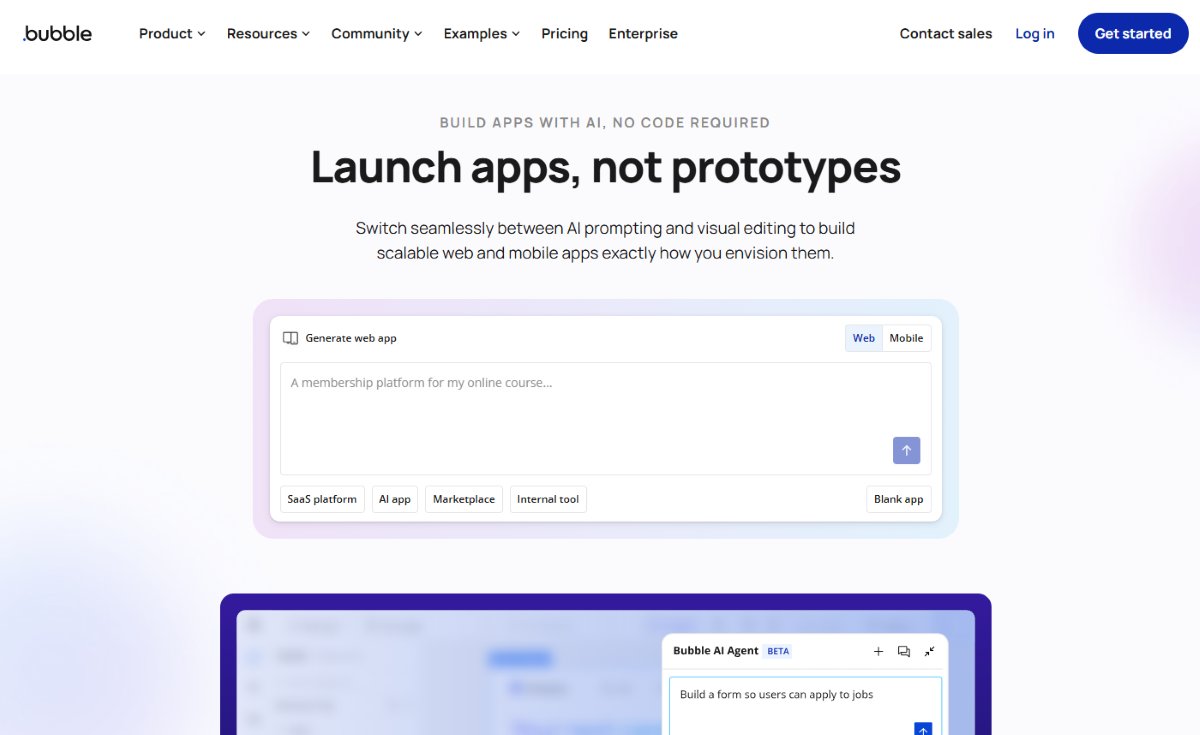
Bubble is the oldest and most developed visual web application builder. Although it is not AI-focused, it offers the best option for developing AI-powered SaaS products, marketplaces, and internal tools entirely within its pluggable ecosystem and API connector.
Key Features
- Full visual editor for front-end UI design and back-end workflow logic
- Native OpenAI and Claude API integrations via the plugin marketplace
- Built-in relational database, user authentication, and Stripe payment processing
- Responsive design editor that produces web and mobile-optimised apps
- 6,000+ third-party plugins covering AI, analytics, and integrations
Pricing
- Free Plan: Unlimited builder access on a Bubble subdomain
- Starter: $32/month — custom domain and basic server capacity
- Growth: $134/month — enhanced workflows and capacity
- Team: $349/month — multi-editor collaboration and priority support
Strengths
- Most powerful no-code platform for complex, multi-page SaaS applications
- An active community of 3 million+ registered builders and extensive documentation
- Highly customizable — closer to real software development than any other no-code tool
Limitations
- Steeper learning curve compared to AI-native no-code platforms
- AI features require third-party plugins — not built-in natively
- Performance optimisation requires manual effort at scale
Best Use Cases
- AI-powered SaaS product MVPs
- Integrated AI custom CRM or ERP solutions.
- Artificial intelligence-based recommendation engines in marketplaces.
- Marketplace applications with AI-driven recommendation engines
Ideal Users: Startup founders/ product managers who are building full-stack web applications but do not hire software developers to build AI capabilities.
2. Stack AI — Best AI-Native LLM Workflow Builder

Stack AI is purpose-built for creating AI-powered applications using large language models. Its visual, node-based interface lets users design LLM pipelines, document processors, and AI agents — with enterprise-grade compliance and zero coding.
Key Features
- Visually drag-and-drop input, output, and AI logic
- Supports GPT-4o, Claude 3, Gemini, Llama 3, and Mistral
- RAG pipelines with PDF, URL, and database ingestion and vector search
- One-click deployment as an API endpoint, chatbot widget, or embeddable form
- SOC 2 Type II compliance with HIPAA-ready data handling
Pricing
- Free: 500 runs/month, 3 projects
- Starter: $199/month — 10,000 runs, custom data sources
- Pro: $799/month — unlimited projects, team collaboration
- Enterprise: Custom — on-premise deployment, SLA
Strengths
- Fastest path from concept to deployed AI application for non-developers
- Exceptional RAG pipeline support — the best in class for document-based AI apps
- Strong enterprise adoption in legal, healthcare, and financial services
Limitations
- Expensive at scale — $199/month Starter tier is restrictive for early-stage SMBs
- Outputs APIs and widgets, not full-featured web application UIs
Best Use Cases
- Document Q&A systems for legal, finance, and HR teams
- Internal knowledge base chatbots trained on proprietary company data
- Data extraction and the reporting generation of structured format are automated
Ideal Users: Stock operations managers, enterprise product initiatives, and corporate entities containing internal AI tools, which are sensitive to compliance.
3. Relevance AI — Best for Building Autonomous AI Agents
Relevance AI has become the market leader in back-office no-code AI solution development, where AI agents (autonomous systems that navigate the web, send mail, process data, and handle multi-step tasks, etc.) are developed with minimal human supervision.
Key Features
- Visual AI Agent builder with memory, tool-calling, and conditional logic
- Pre- Sales Agent, Research Agent, Support Agent, etc
- Connection to 100-plus business apps, like Gmail, Slack, HubSpot and Notion
- Multi-agent coordination — create groups of professionals in AI
- Custom knowledge base ingestion with vector search and semantic retrieval
Pricing
- Free: 100 credits/day, up to 3 agents
- Pro: $19/month – 10,000 credits, any number of agents
- Team:$199/month -Team credit, team workspace
- Business: Custom — dedicated compute and priority support
Strengths
- Most advanced agentic AI capabilities among all no-code platforms reviewed
- Extremely affordable entry at $19/month with generous agent limits
- Pre-built templates save time-to-deploy to less than 30 minutes in typical cases
Limitations
- Pricing based on credit creates uncertainty in high-volume production processes
- Complex agentic tasks still require human review and occasional intervention
Best Use Cases
- Outreach sales for artificial intelligence, lead enrichment, and prospecting
- Competition surveillance, Intelligence, and automated market research
- Tier-1 customer care representatives, who address questions without a human being.
Ideal Users: Digital marketers, sales teams, working alone, would wish to automate tedious research, outreach and support activities to autonomous AI agents.
4. Voiceflow — Best for Conversational AI and Chatbot Design
Voiceflow is the industry standard for designing and deploying conversational AI experiences — from customer support chatbots and interactive FAQ bots to complex multi-turn voice assistants deployed on Amazon Alexa and Google Assistant.
Key Features
- Visual conversation flow designer with condition branches, variable management, and API calls
- Native integrations with OpenAI GPT-4o, Claude 3, and Google Dialogflow
- Dynamic FAQ Response Knowledge base support of document-grounded responses and document-grounded replies
- Multichannel implementation: web-chat, WhatsApp, Alexa, Google Assistant, Teams
- Team collaboration tools with version control and shared component libraries
Pricing
- Sandbox: Free — 2 editors, basic conversational features
- Pro: $50/month — unlimited projects and API integrations
- Teams: $125/month per editor — SSO, advanced analytics
- Enterprise: Custom — dedicated infrastructure and SLA
Strengths
- Best-in-class UX for designing multi-turn conversation logic — used by teams at Amazon and Google
- Allows text chatbot and voice assistant design on one platform
- An effective analytics dashboard to monitor satisfaction level, drop-off points and rate of resolution
Limitations
- Primarily focused on conversation design — not suitable for complex application back-end logic
- Team pricing scales steeply for larger organisations
Best Use Cases
- E-commerce and SaaS e-commerce customer support chatbots
- Live Chat onboarding bots and directed background bots
- Smart smart devices, voice interfaces, accessories and applications
Ideal Users: Product managers, CX (customer experience) teams, and UX designers who develop customer-facing conversational AI, which has quantifiable performance measures.
5. Dify — Best Open-Source No-Code LLM Platform
Dify is an open-source AI development platform built on an LLM, offering the convenience of full self-hosting and a refined no-code interface. It supports agent creation, RAG pipelines, and complex LLM orchestration workflows — making it the top choice for data-sensitive organisations.
Key Features
- Visual workflow canvas for building LLM chains and multi-step agent pipelines
- Supports 100+ LLMs, including local models via Ollama and LM Studio
- Built-in RAG engine with configurable chunking, indexing, and retrieval strategies
- App publishing as a chatbot, REST API, or embeddable website widget
- AWS, GCP, and Azure are full self-hosted either on clouds or on-premises.
Pricing
- Community (Self-Hosted): 100% free – everything, unlimited use
- Sandbox (Cloud): Free- 200 trial credits per month
- Professional: $59/month, individual features: 5,000 credits and professional features
- Team: $159/month — custom model hosting, advanced logs
Strengths
- The only major no-code AI platform with a fully open-source, self-hostable architecture
- Supports local LLMs on private infrastructure — zero data leaves your environment
- These, along with over 50,000+ GitHub stars as of 2026 and a fast-growing number of contributors, have it.
Limitations
- Full self-hosting on any cloud (AWS, GCP, Azure) or on-premise servers
- The cloud version has restrictive credit limits on entry-level plans
Best Use Cases
- Privacy-first AI applications for healthcare, law, and finance services
- Internal AI tools where proprietary data must never reach third-party servers
- Startups requiring full data control and vendor-independent infrastructure
Ideal Users: Technological founders, SMBs that are mindful of DevOps, and teams in an enterprise that need to be rigid in the standards of data sovereignty, GDPR, or HIPAA.
6. Botpress — Best for AI Chatbot Development at Scale
Botpress is a next-generation AI chatbot platform that integrates illustrative bot creation and third-generation LLM natural language perception. It does so in 2026, with autonomous fallback (neutral) behaviour: bots can handle unexpected inputs intelligently without interrupting conversations.
Key Features
- AI-native chatbot builder where LLMs handle intent recognition automatically
- Visual flow designer with entity extraction and contextual memory
- WhatsApp, Telegram, Slack, Zendesk, and the web deployment will be available across multiple channels.
- In-built analytics: conversation success, user drop off and resolution rates.
- Native human handoff integration with live agent escalation
Pricing
- Free: 5 bots, 2,000 monthly AI calls
- Starter: $89/month — unlimited bots, 25 thousand AI calls
- Growth: $495/month – analytics analysis, custom integrations
- Enterprise: Custom whole Next-gen dedicated (white-label)
Strengths
- LLM-powered fallback means bots remain functional even when users ask unexpected questions
- Best multi-channel deployment options among all chatbot-focused platforms in this comparison
- Open-source foundation (v12) with an active developer ecosystem
Limitations
- AI call limits on the Starter plan restrict high-traffic production deployments
- Advanced custom integrations and JavaScript extensions require developer knowledge
Best Use Cases
- Order tracking, returns, and product bots for e-commerce.
- B2B lead qualifier bots scoring and forwarding consumers to sales forces
- Bots that help in HR onboarding and internal policy knowledge
Ideal Users: The marketing teams, customer success managers, and SMB owners who require multi-channel chatbots that are production-grade and have no engineering resources.
7. Make — Best for AI-Powered Business Automation
The most powerful visual automation platform today is Make (formerly Integromat). Although it is not dedicated to AI, its extensive integrations with OpenAI, Anthropic, and Google AI have made it the most effective place to build AI-tailored business operations across your entire software stack.
Key Features
- Visual scenario builder with 1,800+ app integrations across every business category
- Native OpenAI, Claude (Anthropic), and Google AI modules for text, image, and analysis tasks
- Advanced data transformation, parsing, routing, and conditional filtering
- Execution scheduling, webhook triggers, and real-time automation modes
- Full execution history and error handling with automatic retries
Pricing
- Free: 1000 operations per month, 2 scenarios running
- Core: 9-10/month- Unlimited scenarios and 10,000 operations
- Pro: $16/month — full-text execution logs
- Teams: $29/month team work features
Strengths
- Cheapest AI automation platform with an extensive library of third-party integrations.
- Good to give AI logic full integration with CRMs, email platforms, and databases on a single workflow.
- Visual debugging allows one to easily follow and correct failed automation steps.
Limitations
- The chatbots, user-facing applications, and polished user interfaces are not intended
- Complex, high-volume scenarios can exhaust operation limits on lower pricing tiers
Best Use Cases
- Pipelines of automatic generation of content between short and published articles
- AI-led scoring of leads, CRM enhancement and sales workflows automation
- Automation of invoice processing, data extraction, and the back-office AI
Ideal Users: Operations managers, content marketing specialists, and individual founders have automated repetitive multi-step business operations at a low cost with AI.
8. Glide — Best for AI-Enhanced Data-Driven Mobile Apps
Glide is the company that converts spreadsheets and databases into gorgeous mobile-first applications. With AI Columns, its GPT-4o-powered feature, it is possible to automatically classify, summarise, and enrich data without formulas or scripts.
Key Features
- Create apps out of Google Sheets, Excel, Airtable, or SQL databases.
- AI Columns: machine learn to label, summarise, translate, or extract meaning of over a hundred thousand tags of data automatically.
- Drag-and-drop mobile UI-creation system with 40+ built-to-order blocks.
- Role-based user authentication and granular permissions
- Native Stripe integration for building monetised data applications
Pricing
- Free: 500 rows, Glide subdomain hosting
- Maker: $49/month -10,000 rows, personal domain
- Business: 249/month -100 000 rows, enhanced AI
- Enterprise: Customs -15 limited rows, SSO, SLA
Strengths
- Fastest path from a spreadsheet to a functional, professional-grade mobile app
- AI Columns eliminate manual data transformation — no formulas or Python scripts needed
- Exceptional for internal tools: inventory management, field team apps, client portals
Limitations
- Row-based pricing becomes expensive for large datasets on mid-tier plans
- Not suited for complex LLM pipelines, standalone AI agents, or advanced back-end logic
Best Use Cases
- Field team apps with AI-powered data entry validation and auto-classification
- Client portals with automated AI-generated weekly summary reports
- AI-generated product descriptions and Optimization metadata in product catalogues.
Ideal Users: Operations teams: Operations teams optimise and integrate spreadsheet-based business processes into mobile-capable applications.
9. Flowise — Best Open-Source Visual LLM Chain Builder
Flowise is an open-source, drag-and-drop interface for building LangChain and LlamaIndex-based AI applications. It provides a visual environment for constructing complex LLM chains, RAG pipelines, and tool-calling agents — making advanced AI architecture accessible without a single line of Python.
Key Features
- Visual drag-and-drop builder for LangChain chains and LlamaIndex query pipelines
- Supports 50+ LLMs, embedding models, and vector store integrations
- Built-in REST API endpoint generation — every flow becomes a deployable API
- Document loaders for PDF, Notion, Confluence, GitHub, and websites
- Tool-calling agents with web search, calculator, code execution, and custom tools
Pricing
- Self-Hosted: Completely free — unlimited flows and usage
- Cloud Starter: Free — 5 flows, 1,000 predictions/month
- Cloud Pro: $35/month — unlimited flows, team access
Strengths
- Most developer-friendly no-code AI tool — bridges the gap between no-code simplicity and professional LLM engineering
- Fastest way to prototype and deploy LangChain applications without writing Python
- Completely free when self-hosted — zero vendor lock-in, maximum flexibility
Limitations
- Self-hosted deployment requires Docker and basic server administration skills
- UI is less polished than commercial alternatives like Stack AI or Relevance AI
Best Use Cases
- Rapid prototyping of RAG-based AI applications and knowledge retrieval systems
- Custom AI assistants to document internally, use wikis, and SOPs
- Artificial intelligence applications and tools for content strategists and market analysts
Ideal Users: Technical solo founders, people who are interested in AI, or startup teams that need the highest level of architectural flexibility, and zero licensing fees.
10. Coze (by ByteDance) — Best Free AI Bot Builder for Multi-Platform Deployment
Coze is the no-code AI bot-building platform from ByteDance, which was announced internationally in 2024 and soon adopted by content creators, community managers, and indie hackers in 2025 and 2026. It allows users to build AI bots with plugins, knowledge bases, and complex workflows — then deploy them across 10+ messaging platforms, largely for free.
Key Features
- Visual bot builder with a 200+ plugin marketplace (web browsing, image generation, code execution)
- Supports GPT-4o, Gemini, and ByteDance proprietary LLMs
- Built-in knowledge base with PDF and URL ingestion for context-aware responses
- Conditional, multi-step and scheduled bot logic Workflow builder.
- One-step connection to Discord, Telegram, WhatsApp, Slack, LINE, and Feishu.
Pricing
- Free Tier: Generous daily token allowance — most features included
- Pro (Credit Top-Up): Pay-per-use credit system for heavy or commercial usage
Strengths
- Most generous free tier among all major no-code AI bot builders reviewed
- Unmatched multi-platform deployment breadth — from Discord to LINE to Feishu
- The plugin ecosystem enables bots to browse the web, generate images, and execute code autonomously
Limitations
- Data privacy concerns for enterprise users given ByteDance’s ownership and geopolitical context
- Not suitable for complex, multi-page business application development
- Regulatory uncertainty around data handling in the US and EU markets
Best Use Cases
- Discord, Telegram and gaming community management bots
- Individual AI software tools are used by content producers and social media managers
- Fast AI bot development and zero cost experimentation
Ideal Users: Content creators, community managers, and self-educated hackers who need the powerful yet free-of-charge platform to implement and deploy AI bots immediately on multiple messaging platforms.
Platform Comparison Table (2026)
This table will give a quick side-by-side exercise of all 10 platforms on all the most vital decision variables:
| Platform | Best For | Free Plan | Paid Starts | AI-Native | Code-Free |
| Bubble | Full web apps | Yes | $32/mo | Partial | Yes |
| Stack AI | LLM pipelines | Yes | $199/mo | Yes | Yes |
| Relevance AI | AI agents | Yes | $19/mo | Yes | Yes |
| Voiceflow | Voice/chat AI | Yes | $50/mo | Yes | Yes |
| Dify | LLM workflows | Yes (OSS) | $59/mo | Yes | Yes |
| Botpress | AI chatbots | Yes | $89/mo | Yes | Yes |
| Make | Automation | Yes | $9/mo | Partial | Yes |
| Glide | Data apps | Yes | $49/mo | Partial | Yes |
| Flowise | LLM chains | Yes (OSS) | $35/mo | Yes | Yes |
| Coze | AI bots | Yes | Free + credits | Yes | Yes |
Strengths and Limitations of No-Code AI Tools
Collective Strengths
- Speed to Market: AI applications can be implemented, tested and deployed in hours as opposed to months.
- Accessibility: Non-technical end users can assemble production-quality AI tools themselves.
- Cost Efficiency: Does not require ML Engineers or costly infrastructure.
- Rapid Iteration: For flow and logic changes, make them visually, without the need for redeployment or staging cycles.
- Pre-Built Integrations: Ready-to-use 100s of existing business applications.
Key Limitations to Consider
- Scalability Ceiling: Many high-traffic applications will hit scalability limits, requiring expensive upgrades to enterprise plans.
- Customisation Constraints: The developer still needs to create single logic, optimised models or custom UI designs.
- Vendor Lock-In Risk: The majority of proprietary platforms are also locked into the inability to relocate applications to other stacks.
- Data Privacy Exposure: The transmission of sensitive data via the AI API to third parties will be subject to GDPR, HIPAA, and SOC 2 risks.
- Reliability on Free Tiers: Free plans may have rate limits and quota usage for workflow production.
Best Use Cases for No-Code AI Platforms
The biggest factor is selecting the appropriate platform for the particular case. Adhere to the following map: it is one-minute long:
- Build a full SaaS web product: Bubble
- Design autonomous AI sales or research agents: Relevance AI
- Scale Design a Customer support chatbot: Botpress or voiceflow
- Build an internal document Q&A or knowledge tool: Stack AI or Dify
- Make content marketing processes AI-powered: Automate
- Make a spreadsheet smarter: Glide
- Prototype LLM pipelines and RAG systems without code: Flowise
- Deploy an AI bot to Discord, Telegram, or WhatsApp for free: Coze
Expert Recommendations by User Profile
For Startup Founders
Start with Bubble for full-stack web application development. Stack AI or Relevance AI Layer in Stack AI or Relevance AI of AI-specific capabilities. Ship an MVP Fast. Don’t spend too much time on ideal architecture; instead, validate the market and then invest in scalability.
For Digital Marketers
Make is the best choice for AI-based content automation pipelines. CRM Chat Customer-facing AI chat: Combine with Voiceflow or Botpress. Experimenters with a limited budget should first avail themselves of Coze or Relevance AI on its free tier before committing to a paid plan.
For SMB Owners
Glide is the ideal platform for digitising internal operations and field team tools. Botpress delivers customer support automation at a cost SMBs can justify. If data privacy is paramount, Dify self-hosted or Flowise provide full data sovereignty at zero licensing cost.
For Enterprise Teams
Stack AI offers the strongest compliance posture with SOC 2 Type II and HIPAA-ready data handling. Dify offers full data sovereignty, with no vendor reliance and self-hosted data. Voiceflow is the business model of conversational artificial intelligence design and cross-team collaboration.
Future Trends in No-Code AI Development (2026 and Beyond)
- Agentic AI Dominance: Multi-agent systems, such as Relevance AI, will be the new architecture for production AI systems, replacing single-step automation.
- Local LLM Integration: Platforms like Dify and Flowise are enabling private, on-device AI models that eliminate API costs, latency, and data privacy risks entirely.
- AI-Generated Application UI: Tools like Glide are moving toward AI that generates the application interface itself from natural-language descriptions — collapsing no-code into conversational-code.
- Vertical-Specific Platforms: New no-code AI platforms are expected to be offered specifically for legal, healthcare, and financial services and to include built-in regulatory compliance controls.
- Model Agnosticism as Standard: Major platforms will support any LLM (proprietary or open-source) and enable users to make trade-offs among cost, capability, and compliance.
- Real-Time Collaboration: No-code AI platforms will be built to enable team-based design workflows, version control, and branching, which are traditionally associated with enterprise software creation tools, for non-technical builders.
Conclusion
The no-code AI development market in 2026 is complex, diverse, and a significant force. The no-code platform can be found in all three cases: as a founder producing an AI SaaS, as a marketer automating content processes, and as an SME owner managing operations and digitising. It is certain that a no-code platform can serve your unique needs and financial constraints.
The most appropriate platform will be determined by your job-to-be-done.
- Best overall for full web apps: Bubble
- Best AI-native agent platform: Relevance AI
- Best chatbots and conversational AI: Botpress or Voiceflow
- Best for LLM workflow development: Stack AI (managed) or Dify (open-source)
- Best for business process automation: Make
- Best for spreadsheet-to-app transformation: Glide
- Best free option for bot builders: Coze
Begin with the free package of your platform of choice. Develop a concentrated demonstration. Measure the outcome. Then scale your plan only when real usage justifies the cost. The barrier to building production-quality AI products in 2026 has never been lower — and the upside has never been higher.
About This Guide
This article was researched and written by the Techi9 Editorial Team. Pricing and feature data reflect publicly available information as of March 2026. All platforms were evaluated independently