


Email remains one of the most powerful marketing channels, but with overflowing inboxes and rising customer expectations, relevance has become the true differentiator. The conventional one-size-fits-all campaign approach has lost its edge. Marketers are rapidly turning to Artificial Intelligence (AI) and Machine Learning (ML) to craft hyper-personalized email experiences that engage, convert, and retain customers at scale.
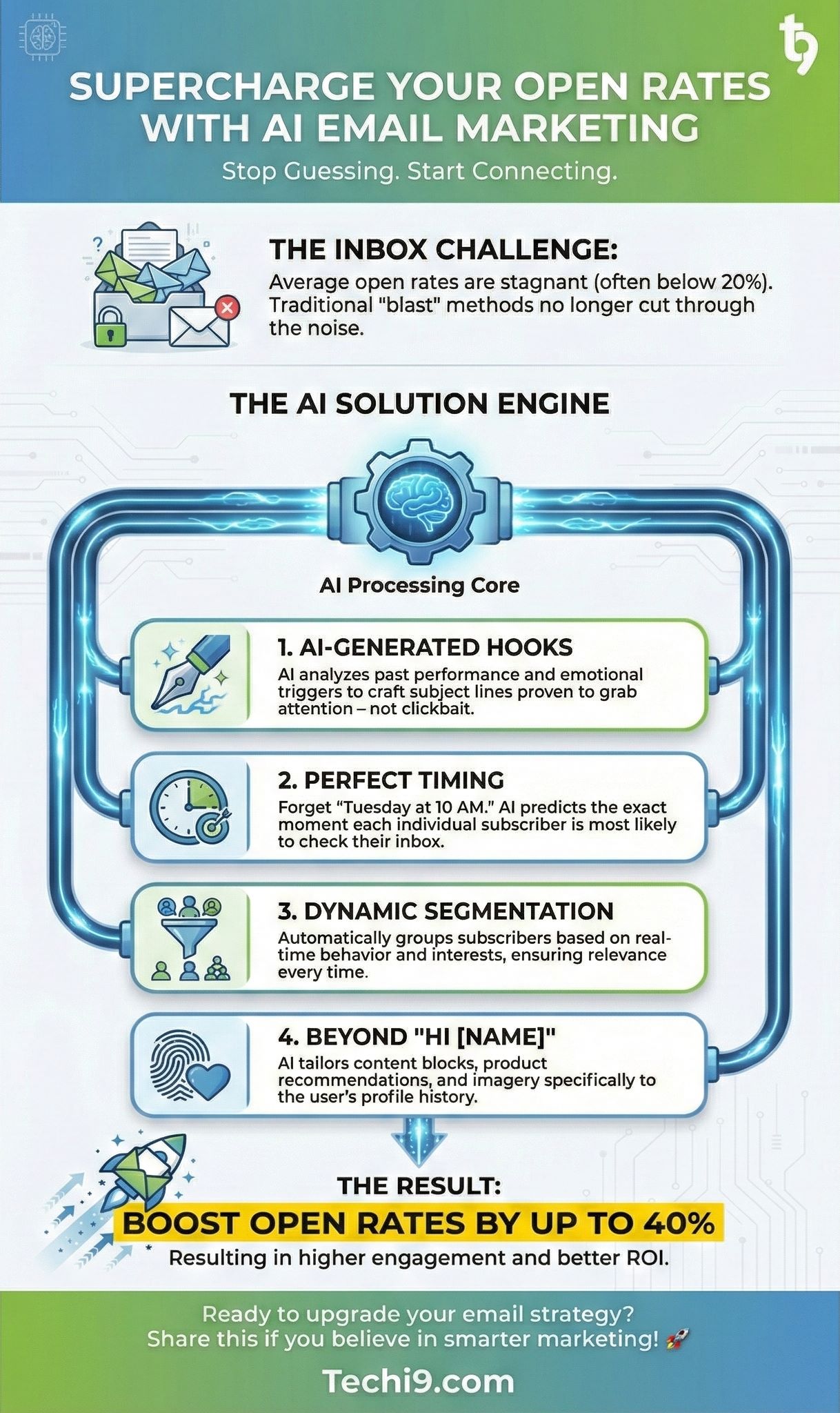
According to the Salesforce State of Marketing report, around 84% of marketers now use AI in some form, with a strong focus on email personalization. The impact has been tangible—Insider reports that brands employing predictive personalization achieve up to 40% higher open rates and 25% higher conversion rates.
Let’s explore how AI is redefining email marketing and enabling true personalization at scale.
Smarter Segmentation: From Demographics to Dynamic Personas
Unlike traditional segmentation based on static factors like age, gender, or location, AI-powered behavioral and predictive segmentation dynamically categorizes users based on real-time intent, engagement, and lifecycle stage. This allows marketers to deliver contextually relevant emails that increase open rates, engagement, and conversions.
Key benefits
- Predictive behavior analysis: AI identifies subtle patterns in browsing, purchase, and engagement data to forecast upcoming user actions.
- Dynamic audience updates: As customer behavior evolves, segmentation, tone, and email themes automatically adjust to stay relevant.
- Higher engagement: Contextual content tailored to each customer journey significantly improves open and click-through rates.
For example, the predictive segmentation engine by Insider uses over 100 behavioral parameters to group audiences by intent. It empowers retailers and e-commerce brands to deliver timely campaigns that align with audience interests—consistently outperforming traditional list-based campaigns.
Hyper-Personalized Content: Crafting Messages That Resonate
AI takes personalization to the next level. Using ML algorithms, it analyzes purchase history, browsing patterns, and even sentiment from previous interactions to personalize subject lines, content blocks, and product recommendations for every user.
Key advantages
- Natural language personalization: AI tools generate unique subject lines with personalized tone, emotion, and structure.
- Dynamic product recommendations: Smart engines suggest products based on past behavior to drive higher clicks and conversions.
- Real-time contextual relevance: Email content automatically adapts to triggers such as weather, location, or current trends.
For instance, Sephora uses AI to analyze customer browsing and buying history, personalizing product suggestions and tutorials. This has boosted their email click-through rates by over 22%, clearly showing how relevance drives response.
Predictive Send Times and Frequency Optimization
In generative ai in email marketing, timing is as critical as the message itself. AI-powered predictive analytics models determine the best send times for each recipient by analyzing individual engagement patterns—like when users typically open, click, or respond.
Key Benefits
- Time-based optimization: Predictive models ensure every subscriber receives an email when they’re most likely to engage.
- Frequency control: AI fine-tunes campaign frequency for each user, reducing the risk of annoyance or fatigue.
- Automated testing: Continuously evolving algorithms refine send-time strategies using real campaign data.
For example, Salesforce Marketing Cloud Einstein uses engagement scoring and Send-Time Optimization (STO) to identify optimal response windows. This typically improves open rates by 10–20%, maximizing engagement and ROI across large subscriber bases while saving time for marketers.
AI-Driven A/B Testing and Continuous Learning
AI accelerates and enhances A/B testing through multivariate analysis, simultaneously evaluating multiple variables (such as subject lines, visuals, CTAs, and layouts) to find the best-performing combinations in real time.
Core strengths:
- Faster experimentation: AI eliminates guesswork by instantly identifying top-performing variations.
- Deeper insights: Algorithms uncover complex relationships between content elements and audience behavior.
- Adaptive improvement: With every new dataset, AI refines strategies for continuously evolving campaigns.
Leading marketing platforms use natural language processing (NLP) and reinforcement learning to automatically test, refine, and optimize email versions—ensuring incremental improvements with every send.
Measuring Impact: Data-Driven ROI and Ethical AI Use
AI not only enhances personalization but also enables transparent measurement and ethical data practices. By responsibly managing customer data, brands can strengthen trust while maintaining compliance with global privacy regulations.
Strategic imperatives:
- ROI tracking: AI tools unify data across campaigns, allowing marketers to measure engagement uplift, conversion impact, and lifetime value.
- Customer trust: Transparent communication about AI use builds confidence and long-term loyalty.
- Ethical algorithms: Using bias-free datasets ensures equitable personalization without stereotyping or exclusion.
According to McKinsey’s AI in Marketing report, organizations actively tracking AI-driven marketing ROI are three times more likely to outperform peers in retention and satisfaction. Frameworks like GDPR and CCPA further push brands to balance personalization with privacy, making ethical AI a true competitive advantage.
Infographics
Conclusion
AI has transformed using ai in email marketing from campaign-based broadcasting to intelligent, context-aware communication. Through predictive segmentation, personalized recommendations, and adaptive learning, AI enables brands to engage millions of users—each with a unique, tailored experience.
As more organizations embrace AI-powered marketing, the focus will shift from just achieving higher open rates to building deeper customer relationships grounded in relevance, timing, and trust.
In this era of intelligent marketing, personalization at scale is not merely about boosting sales—it’s about understanding customers better, predicting their needs, and delivering value when it matters most. These contextual, humanized experiences are what lead to lasting relationships and sustained business growth.