

The AI-powered SaaS tools and AI-as-a-Service (AIaaS) products are placed at the next tier of artificial intelligence. AI-powered SaaS tools have revolutionized the industry. Previously, the power of AI was enjoyed only by large companies such as Google or Amazon. AIaaS (AI-as-a-Service) is now available to the founders of SaaS, with enormous AI functions without huge budgets or huge teams of data scientists.
The AI-as-a-Service is a pay-as-you-go system in which firms can pay subscription charges rather than developing their own artificial intelligence systems. It offers features like machine learning, automation, analytics, and natural language processing, among others, to startups at no-commitment subscription prices. With the help of AI-powered SaaS tools, this is altering the way products of SaaS products are developed, upsized, and provided.
What Exactly is AI-as-a-Service?
Artificial intelligence as a service (AIaaS) refers to AI services and tools that have been placed in the cloud environment. It also does not require extensive infrastructure and constant maintenance, which provides easy access to AI features to the user.
The AIaaS enables companies and developers to apply AI technologies (such as machine learning, deep learning, natural language processing, and computer vision) using APIs or other cloud-based solutions. Most of the apps have low-code interfaces, drag and drop options, and templates that allow individuals with no technical background to build AI-powered SaaS tools within a few days.
It first presents APIs in the analysis of data. Second, it handles the heavy lifting through cloud platforms like Azure AI, which provides pre-assembled models. This isn’t just hype—recent data shows the AIaaS market is projected to reach $723 billion by 2025, indicating huge growth.
Why AIaaS is a Game Changer for SaaS Founders
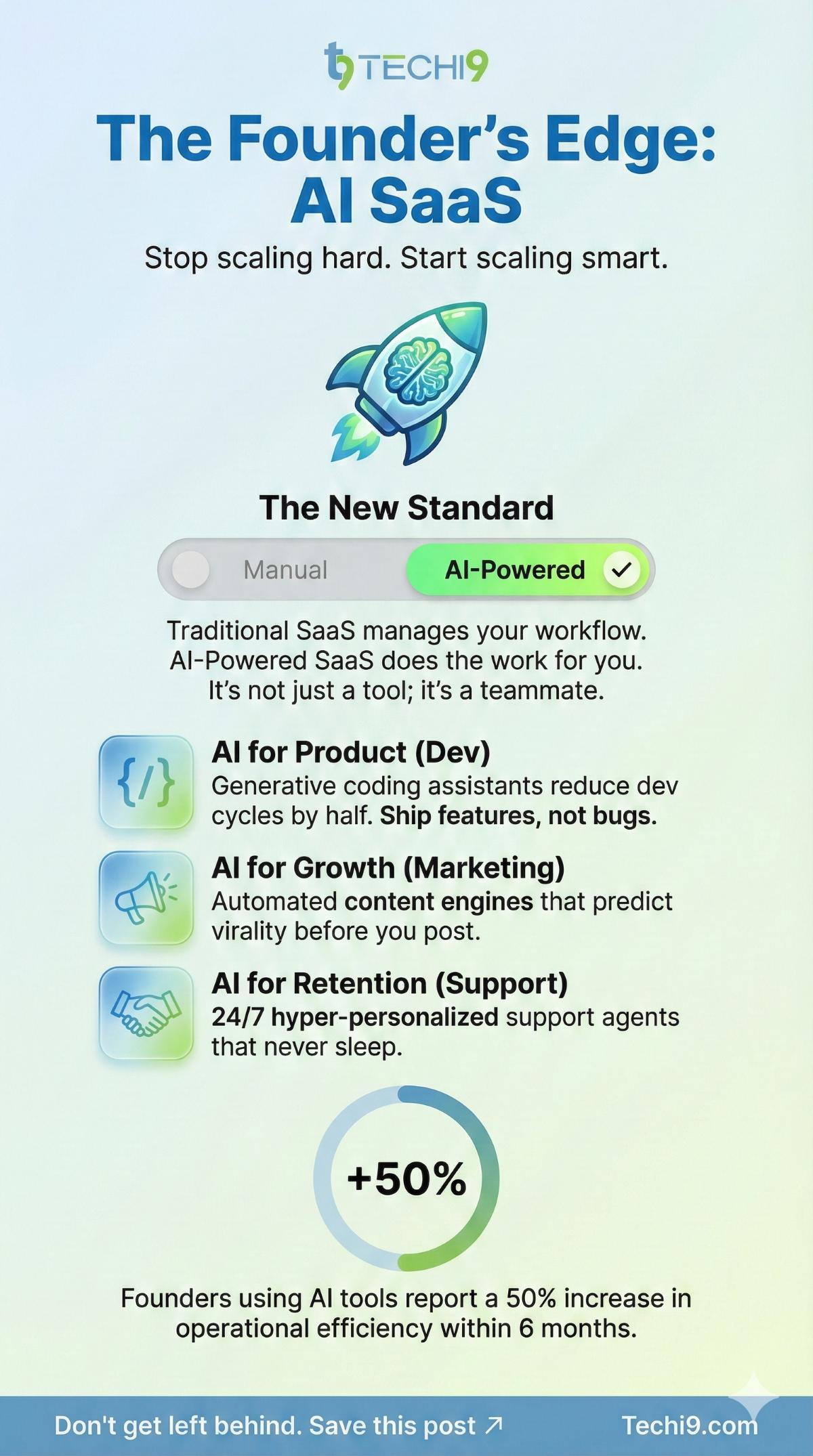
AIaaS redefines the cost, speed, and ambition levels of SaaS products. It enables rapid experimentation, integration of intelligent features that customers now expect, and competition with larger firms—all without owning extensive infrastructure.
In simple terms, AIaaS is an elastic, cheap, and affordable AI solution for all.
Benefits of AI-powered SaaS Tools for Startups
AI-powered SaaS tools are designed to automate tasks, personalize experiences, and make predictions—typically offered via subscription, integrated with AI. For SaaS startups, these tools go beyond features—they often form the foundation of the value proposition.
Personalization and Customer Centric Experiences
AI facilitates easier personalization and customer-centered experiences. It allows the formation of user-initiated experiences on the basis of behavior, preferences, and context.
- Recommendation engines suggest behaviors, features, or content based on previous interactions. They support live user needs and goals.
- Recommendation engines are suggestive algorithms that provide suggestions or proposals of behavior, feature, or content, based on past interactions.
Thus, AI-powered SaaS tools will be able to drive user engagement and retention due to less effort to achieve faster and more relevant user experiences.
Robotization and Efficiency
AI excels in doing repetitive and data-intensive jobs, thus humans can concentrate on activities that are of high value. In the case of SaaS companies, this results in improved margins and faster service.
Examples include:
- AI chatbots that answer routine support questions in real-time and pass through difficult ones to support agents.
Consequently, AI-powered SaaS tools are more cost-effective in the long term since teams are able to increase service delivery without increasing human numbers on equal measure.
Intelligent Analytics and Prediction-based Decisions

AIaaS solutions can be used to process raw product data into meaningful information using predictive analytics and pattern recognition. It is very helpful when SaaS founders have to determine what to develop next, when churn risk is increasing, or what customers are most valuable.
In addition, AI experimentation is capable of running A/B tests more quickly and recommending winning variants, whether of prices, UX, or feature sets.
Speed Up Your Launch
Time kills startups. AIaaS deploys in days, not months. Pre-built models cut dev time. Zendesk uses AI agents for quick support. Founders copy this fast. Meanwhile, traditional coding slows you. AIaaS keeps you ahead.
Cost Savings That Matter
Building AI from scratch? It drains funds. AIaaS uses pay-as-you-go. You pay only for what you use. A small SaaS team saves 40% on ops. That’s cash for marketing. For example, AWS AI lets you start free. Scale as users grow.
Faster Time-to-Market
The founders can incorporate ready AI APIs and go live in weeks instead of months or years to train models.
Scalability
The AIAaS systems are cloud solutions. Businesses are able to expand and contract without purchasing new infrastructure, depending on the demand.
Your SaaS booms? AIaaS handles spikes. Cloud auto-scales resources. No server crashes during peaks. This means happy users and steady revenue. Moreover, it boosts security. Providers like Microsoft guard data.
Boost User Engagement
Smart features keep users hooked. AI personalizes dashboards. Think Netflix recommendations, but for your tool. Churn drops 20%. As a result, lifetime value rises.
Increased Competitive Advantage
The competitive nature of the industries implies that AI capabilities are what can make the difference between attracting and losing customers.
What Makes AI-Powered SaaS Tools Valuable?
Autonomous assistive AI-powered SaaS tools assist users in working quickly, making better choices, and automatically solving issues. They do not behave in aclosed tool, but learn, predict, and adapt.
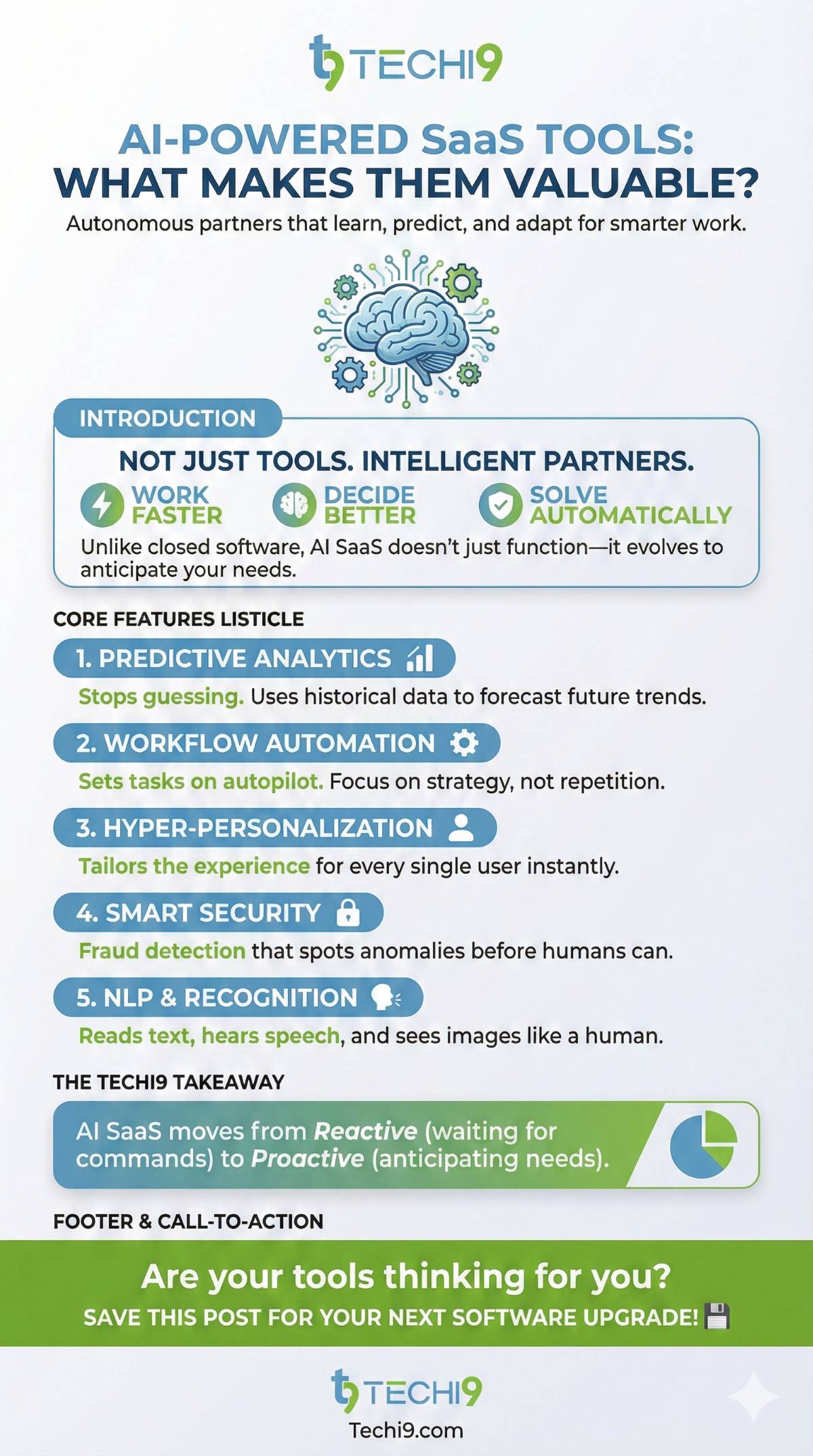
Some core features include:
- Predictive analytics
- Workflow automation
- Smart recommendations
- Personalization engines
- Fraud detection
- Natural language processing
- Image and speech recognition
It is due to this that the user receives a smarter interface that makes the process almost similar to sharing with a smart assistant.
Common AIaaS Use Cases for SaaS Products
AIaaS can power many features across different SaaS verticals. The most popular use cases cluster around support, sales, marketing, product intelligence, and security.
Customer support and success
SaaS users expect quick answers and self-service options. AIaaS helps teams deliver this without 24/7 human coverage.
- AI chatbots that respond to the FAQs based on your expertise base and website content.
- An intelligent route that redirects complicated problems to the appropriate expert depending on the subject and urgency.
- These AI-based SaaS help eliminate wait times, enhance satisfaction, and boost renewal and expansion rates.
Such AI-powered SaaS tools minimise waiting times and maximise satisfaction, helping to increase renewal and expansion rates.
Marketing, Sales, and Revenue Operations
The AiAaS is also changing the manner in which SaaS founders carry out go-to-market strategies. Even little teams can manage advanced campaigns with the appropriate tools.
- Prospect scoring models give priority to intent and fit scores.
- Generative AI-generated emails, advertisements, and landing page text that can be edited by human beings.
Unlike guesswork, these AI-powered SaaS tools assist the teams in remaining focused on the areas that have the most significant impact.
Product Intelligence and User Research
SaaS founders need to learn from user behavior quickly. AIaaS can surface patterns that would be hard to spot manually.
- The clustering of feature utilisation shows which features are motivating adoption, and which ones are misleading the user.
- Predicting churn, but focusing on potentially at-risk accounts prior to the accounts going away.
Threat Detection in Cyberspace
It assists the tracking networks, observing suspicious activities and avoiding breaches in time.
Workflow Automation
AI eliminates repetitive human tasks and improves work efficiency between different teams.
How AIaaS is Transforming SaaS Development Models
The SaaS business is developing at a high pace. Earlier, the SaaS products were products that offered solutions to specific tasks.

Some major shifts include:
- Traditional dashboards are turning into predictive insights.
- Manual processes are shifting to automation.
- Platforms are becoming more dynamic and personalized.
- Support teams are using AI-assisted response systems.
Because of these improvements, AI-powered SaaS tools are now expected—not optional.
Examples of AIaaS Providers and AI-powered SaaS Tools
There are two significant categories of AIaaS market players, namely hyperscale cloud service providers and niche AI providers. Both teams drive the next generation of AI-powered SaaS tools, which founders can create or combine.
Hyperscale cloud providers
Big data cloud giants control a significant portion of AIaaS. They bundle AI APIs, machine learning platforms, and managed services into their clouds.
While specific names and offerings vary, common patterns include:
- Pre-trained models for vision, language, translation, and speech.
- AutoML tools assist the team in building custom models by operating on their own data.
- AI-optimized infrastructure services such as GPUs and special purpose chips.
Specialized AIaaS platforms
Specialized AIaaS platforms focus on particular problems like unstructured data, customer engagement, or analytics. They typically offer simpler onboarding and targeted features.
Top AIaaS Platforms Founders Are Using saas ai tools
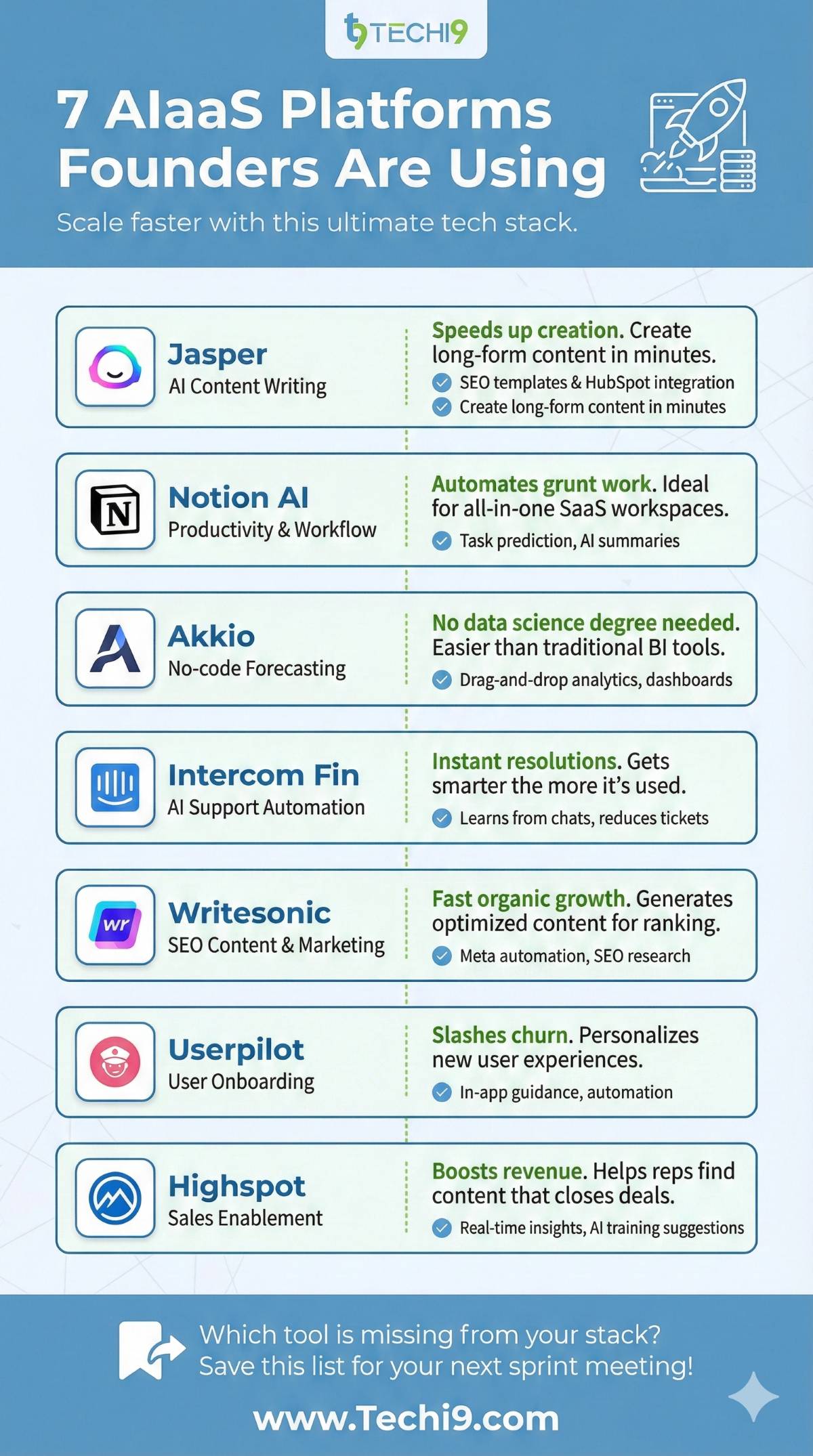
| Tool Name | Best Use Case | Why It’s Valuable | Key Features | Key Features |
| Jasper | AI content writing | Speeds up content creation for blogs and emails | SEO templates, HubSpot integration | Create long-form content in minutes |
| Notion AI | Productivity and workflow | Automates notes, summaries, and task planning | Task prediction, AI summaries | Ideal for all-in-one SaaS workspaces |
| Akkio | No-code forecasting | Builds predictive models without technical skills | Drag-and-drop analytics, dashboards | Easier to use than traditional BI tools |
| Intercom Fin | AI support automation | Handles customer queries instantly | Learns from chats, reduces tickets | Gets smarter the more it’s used |
| Writesonic | SEO content and marketing | Generates optimized content for ranking and ads | Meta automation, SEO research | Great for fast organic traffic growth |
| Userpilot | User onboarding | Personalizes new user experiences to reduce churn | In-app guidance, automation | Works best when combined with analytics |
| Highspot | Sales enablement | Helps reps find content that closes deals | Real-time insights, AI training suggestions | Boosts team productivity and revenue |
How to Get Started With AIaaS as a SaaS founder
As AIaaS, the initial step may be a demanding one and can be recognized with the help of a systematic approach. It is important to begin big, test slowly, and keep on bettering it.
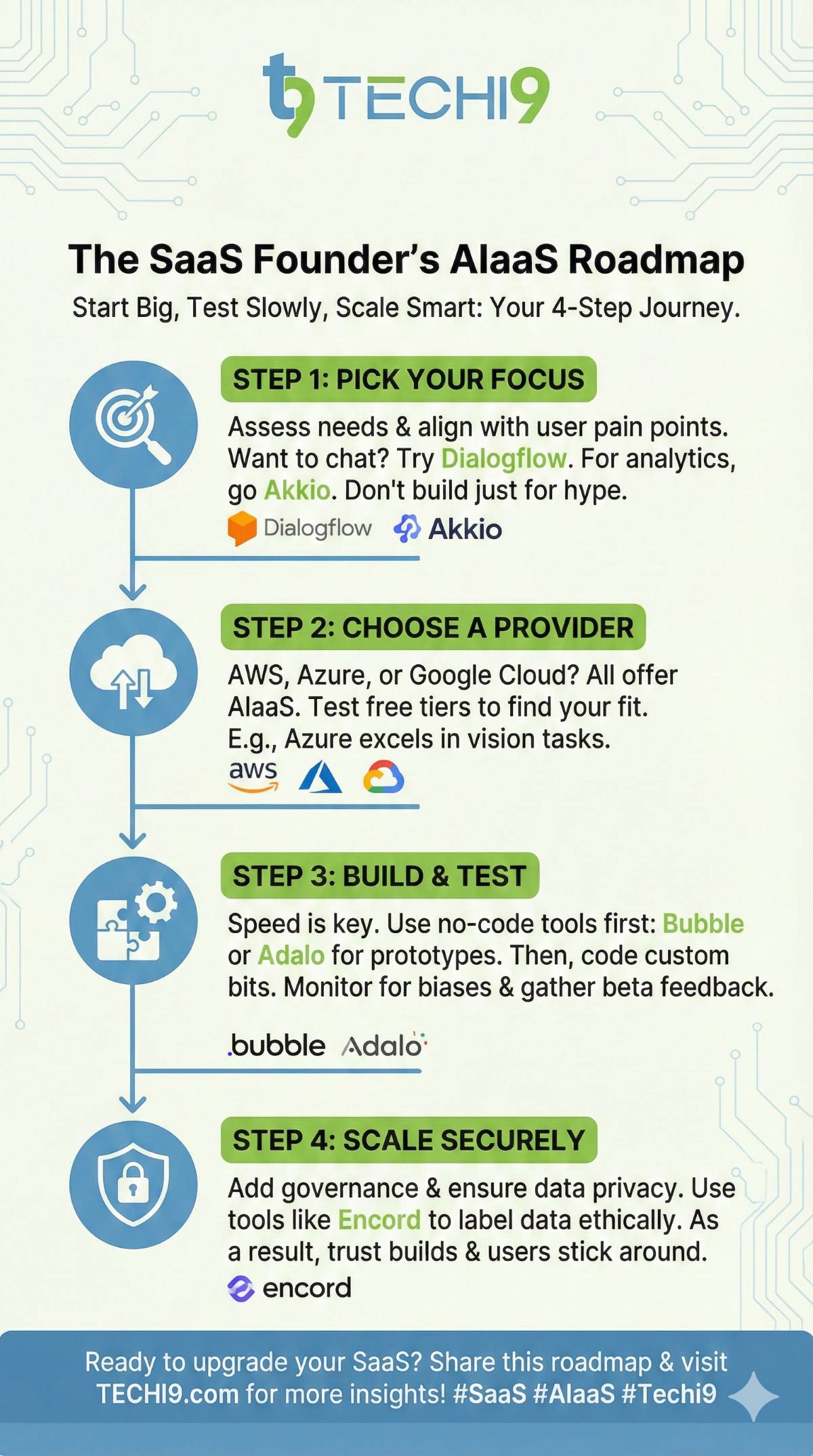
Step 1: Pick Your Focus
Assess needs. Want to chat? Try Dialogflow. For analytics, go Akkio. Align with user pain points.
Step 2: Choose a Provider
AWS, Azure, or Google Cloud? All offer AIaaS. Test free tiers. See what fits your stack. For example, Azure excels in vision tasks.
Step 3: Build and Test
Use no-code tools first. Bubble or Adalo speed prototypes. Then, code custom bits. Monitor for biases. Additionally, gather beta feedback. Refine quickly.
Step 4: Scale Securely
Add governance. Ensure data privacy. Tools like Encord label data ethically. As a result, trust builds. Users stick around.
Challenges and Risks SaaS Founders Must Manage
Although AIaaS has many advantages, there are already new threats that the founders should take into account. Failure to address such problems may harm the trust and resilience of users.
Privacy, Security and Compliance of Data
With AIaaS, it can imply transferring data to third parties. This leaves questions about who is authorized to access the data, its storage and protection.
Founders should:
- Examine the encryption of each provider, as well as, access control and compliance certification.
- Strictly minimize the data and deliver only the data necessary to accomplish the AI activity.
- Be open and do not be secretive with customers on how AI-powered SaaS tools use their data.
Vendor Lock-in and Flexibility
When a single provider of AIaaS is over-used, it can result in lock-in. The switch can be hurting in case terms are tightened or pricing altered.
To reduce this risk:
- Prefer the providers that accept standard formats and export capabilities.
- Architecture Design your architecture with easy switching provider layers.
In the meantime, keeping an eye on newcomers and changing proposals makes your AI-powered SaaS tools flexible and competitive.
Ethics, bias, and user trust
The training data used in AI models may be biased. In the case of SaaS products, this may be manifested in unjustified recommendations, biased decisions, or insensitive automation.
Guardrails need to be set by founders and they include:
- High impact decisions such as credit, hiring or moderation where possible should be reviewed by humans.
- Periodic review of model outputs in order to pick and rectify biased behavior.
- Effective communication within the apps clarifying what the AI is and where its boundaries are.
Future Trends Shaping AIaaS and AI-powered SaaS
AIaaS is changing rapidly, and companies that keep up with the trends have the possibility to create a product which remains at the forefront. Intelligence is becoming still more user-and workflow-proximate to a number of developments.
Edge AI and vertical AI stacks
Edge AI takes models nearer to the devices and users, minimizing the latency as well as enhancing privacy. It will be significant to SaaS tools that are applied within industries such as manufacturing, logistics, healthcare, and IoT.
Hence future AI-powered SaaS tools might be based on industry-specific AIaaS based on the data and workflow of a specific sector and regulations.
Low-code AI and agentic workflows
The non-technical founders and teams are finding it easier to design flows and automations with low-code and no-code AI. Multistep tasks that involve software agents starting with little to no human direction are also on the rise (agentic AI).
With such abilities, developing AI-powered SaaS tools will not look like software engineering anymore, but rather a coordination of agents and components. The change will also make AI more democratic, as more founders will be encouraged to roll out bold products.
FAQ: Trending Questions on
What are AI SaaS tools?
AI SaaS tools are software applications that utilize artificial intelligence and are delivered via the Software as a Service model, allowing users to access them over the internet on a subscription basis. Examples include AI-driven analytics, customer support chatbots, and automated marketing platforms.
What are SaaS platforms for AI best for?
SaaS platforms for AI are best for automating tasks, data analysis, customer service, personalized marketing, predictive analytics, and enhancing decision-making processes. They provide scalable solutions without the need for extensive infrastructure investment.
How to use AI in SaaS products?
Implement chatbots for customer support to provide instant responses.
Use machine learning algorithms for personalized user experiences and recommendations.
Integrate AI analytics to analyze user behavior and optimize product features.
Automate data entry and processing tasks using AI tools.
Incorporate natural language processing (NLP) for enhanced search functionality.
Leverage predictive analytics to forecast trends and improve decision-making.
Utilize AI for automated testing and quality assurance in software development.
Develop intelligent onboarding processes to guide new users effectively.
Implement AI-driven marketing tools for targeted campaigns and lead generation.
Use sentiment analysis to gauge user feedback and improve product offerings.
What are the top 10 AI tools?
ChatGPT
Jasper
Copy.ai
Writesonic
Grammarly
Surfer SEO
Frase
SEMrush
Clearscope
Lumen5
Final Thoughts
SaaS products are being transformed by AI-as-a-Service products. It has reduced entry obstacles, and AI is available to start-ups, founders and small teams. With the evolution of AI use, SaaS solutions will be better, more intelligent and personalized.
As a founder, this is the most appropriate moment to incorporate AI features in your product. You could lose customers to those rivals that can move to automation and intelligence at a faster pace.
AI is not the future.It is already here.

