


Generative AI Tools content creation of text, images, videos, and audio by artificial intelligence. These AI’s are trained on large data sets and produce new content that is made to seem like humans have created.
Suppose you could create a blog post, create a beautiful picture, or create a little video in a few minutes. The force of Generative AI Tools is associated with that power. This AI uses intelligent algorithms to create novel content with the help of simple prompts. It resembles human imagination, and it is much quicker.
Brands nowadays are publishing more than ever. But speed, scale, and quality are difficult to strike a balance between. That is where the Generative AI Tools comes in. It is time-saving, cost-reduction and assists teams to remain standardized across mediums.
This guide will include all the information we need to know about Generative AI Tool. We’ll start with the basics. Thereafter, we will submerge ourselves in writing, image, and video tools. Examples of generative AI will be shown.
Let us learn it step by step. To begin with, define generative AI.
Understanding Generative AI Content Creation?
Generative AI Tools is the process of creating original material by using AI models that are based on massive data volumes. It studies large data sets in order to generate a text, image, sound, or video on the input of the user.
This technology is based on models such as transformers. They extrapolate trends and produce human-made outputs. For example, one just enters a query, and AI generates a tale or an image. It is not simply copying, it is inventing.
However, it’s not perfect. The initial ones had problems with precision. Modelled now, in 2026, things are more sophisticated. They handle nuance better. Consider it as an artistic collaborator, and not a substitute. Also, this AI opens up to synthetic media. It contains false yet truthful videos or voices. This opens the way to generative content in films or advertisements.
The Importance of Generative AI Content Creation in 2026
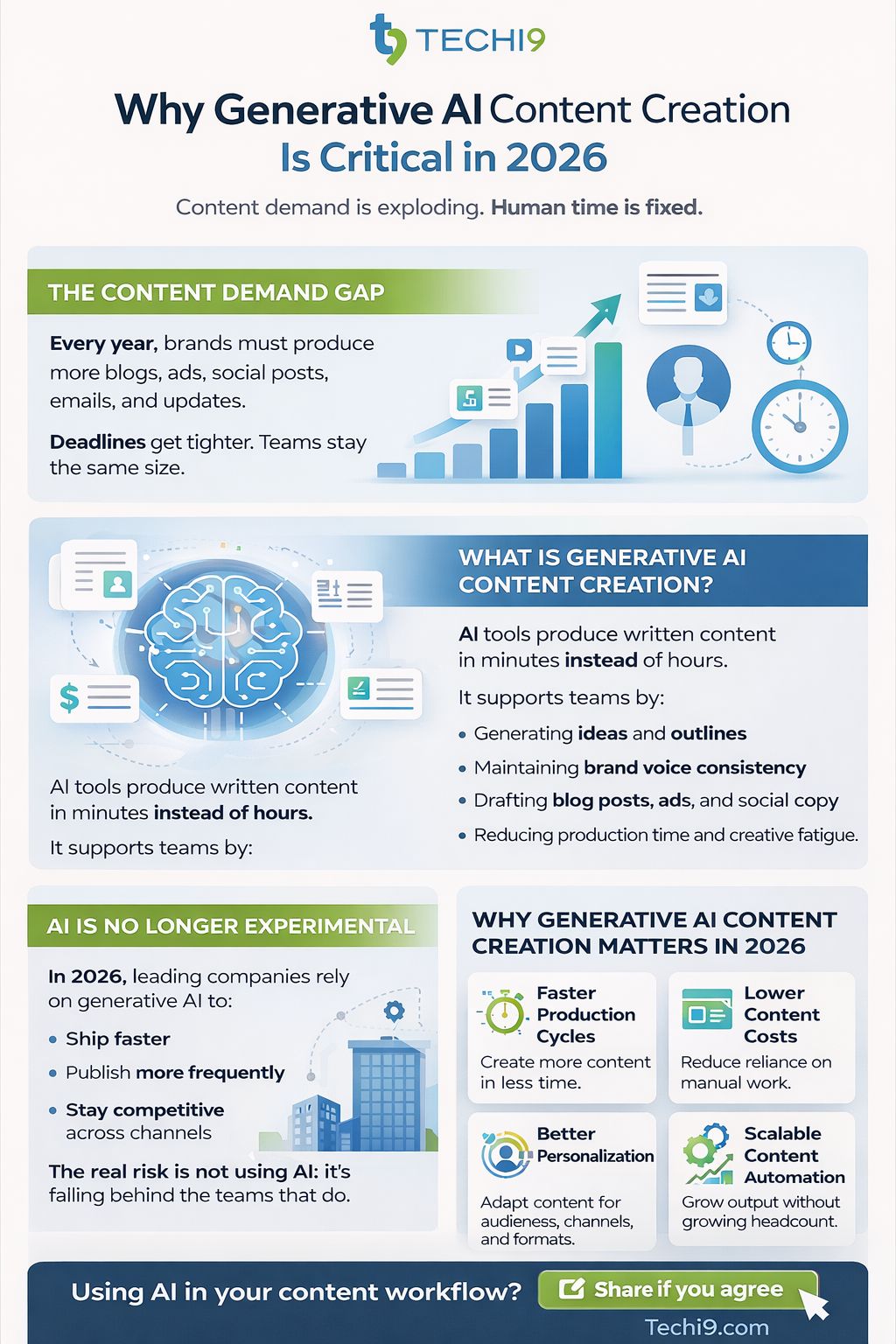
Content demand keeps growing. Human time does not.
Rising content demand
Content demand refers to the constant need for more blogs, ads, posts, and updates across platforms. It keeps increasing every year.
Human time, however, stays limited. Creators are expected to do more, faster, often with the same resources and tighter deadlines.
Generative AI Tools
Generative AI content creation is the use of AI tools to create written content quickly and efficiently. It takes fewer hours or minutes before production time is lowered. In addition to speed, it assists in idea generation, brand voice, and in assisting actual tasks such as ad copy, landing page, and social media copy.
Industry adoption in 2026
AI has become a reality in daily content workflow — it is no longer an experiment. The largest companies depend on it already. In order to remain competitive, instead of trying to keep up with AI content generation tools, teams must start using these tools themselves.
From optional to essential
When a tool becomes essential, work cannot scale without it. Generative AI content creation has reached that point. Brands now publish across more platforms than ever, and AI enables that volume without overwhelming content teams.
Search engine expectations
The search engines give preference to fresh, relevant, and clear content. It is hard to achieve these standards at scale. AI assists teams in reaching such heights and minimizing redundant work and creative fatigue.
Key reasons it matters:
- Faster production cycles
- Lower content costs
- Better personalization
- Scalable content automation
How do Generative ai tools work
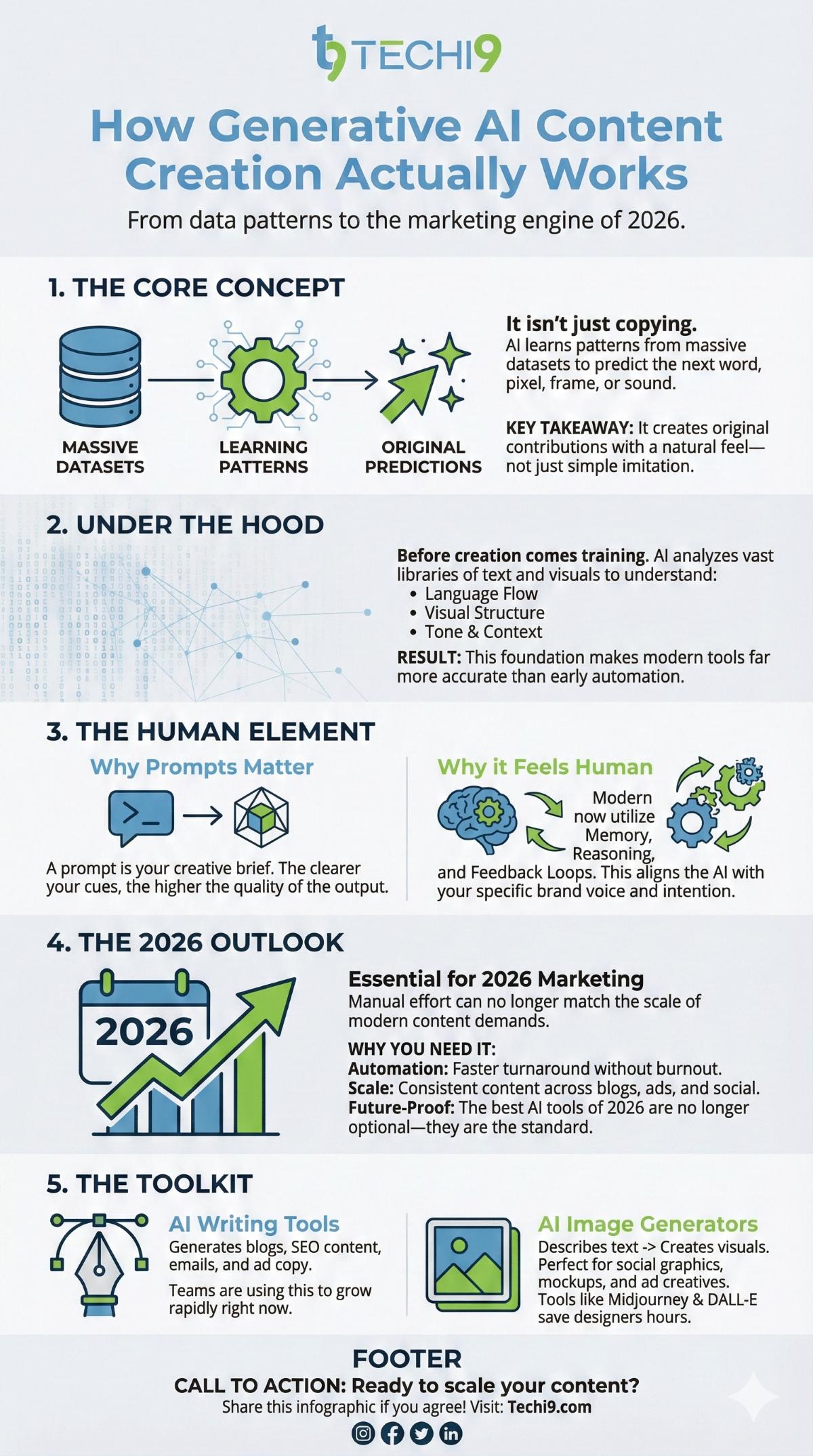
Generative AI Tools works by learning patterns from massive datasets. The AI then predicts the next word, pixel, frame, or sound.
What it actually means
Generative AI content creation refers to the use of AI systems that can learn and produce new content based on an enormous volume of data. This may be in the form of text, pictures, videos, or even audio. Rather than imitating anything, the AI learns patterns and generates original contributions, which have a sense of naturalness and can be used in the real world.
How the learning happens
Before any content is created, the AI is trained on large datasets. This training helps it understand language flow, visuals, tone, and structure. This foundation is what powers modern AI content creator software and makes today’s tools far more accurate than early automation tools.
Why prompts matter so much
A prompt is simply your instruction to the AI. Imagine briefing a writer or a designer. Clearer cues will achieve a higher score, be it using AI Writing Tools, an AI image generator, oran AI video maker generative .
Why newer tools feel more human
Memory, reasoning, and feedback loops are now a part of modern systems. Such improvements allow AI content generation tools to be smarter, more predictable, and more brand voice/brand intention aligned.
Why is it essential to the marketing of 2026?
By 2026, brands are producing content at a scale that manual effort alone cannot handle. That is why Generative AI marketing tools and the best AI for content creation 2026 are no longer optional.
They enable Content Automation, faster turnaround, and real generative AI examples across blogs, ads, social posts, images, and videos without burning teams out.
Types of generative ai tools for Content Creation
AI Writing Tools
AI writing tools generate blogs, emails, ads, scripts, and more. They understand tone, intent, and structure.
Popular use cases include:
- Blog writing
- SEO content
- Ad copy
- Product descriptions
In the current time, many teams are using AI copywriting to grow more rapidly.
AI Image Generator
An AI image generator is an application that generates an image based on text prompts. You describe what you want. The AI creates it.
These tools power:
fewer resources.
AI Content Creator Software for Businesses
AI content creator software helps brands manage content end-to-end.
Key features include:
- Multi-format creation
- Team collaboration
- Publishing workflows
- Analytics integration
Such platforms support automated content strategies without chaos.
Generative AI Tools for Marketing
Generative AI marketing tools focus on performance-driven content.
They help with:
- Ad variations
- Email personalization
- Landing page copy
- Social captions
For example, marketers use generative ai examples like dynamic product descriptions based on user behavior.
Therefore, conversion rates improve without extra effort.
AI Writing Tools: A Deep Dive
What they are
AI writing tools are software powered by Generative AI content creation that help produce written content faster while keeping quality high. They’re not just for short blurbs anymore; today’s tools handle long-form content that can compete in SEO.
How they help
Professional creators use these tools to build:
- Keyword integration that aligns text with search intent
- Content outlines that give structure before writing
- Readability improvement so the content flows better
- Tone control to match brand voice
This is where AI content generation tools start to show real value. They speed up drafting and shape ideas, but human editors still add accuracy, nuance, and judgment. In other words, AI copywriting accelerates work, and humans refine it.
AI Image Generator Use Cases
What it is
An AI image generator uses Generative AI content creation principles to create custom visuals based on your input. It goes beyond generic stock images to produce something tailored and on-brand.
Where it shines
Creators are using these tools for:
- Custom blog visuals that support written content
- Branded social posts with unique style
- Concept art for storytelling or mood boards
- Thumbnails for videos that attract clicks
These images improve engagement because they’re original and contextually relevant. As synthetic media, they help your work stand out rather than look like everyone else’s.
AI Video Maker Generative for Short-Form Content
What it is
An AI video maker is software that automatically creates or edits video clips using machine learning. It’s a subset of automated content that lets you produce videos without expensive gear or long editing cycles.
Where it works best
Short-form platforms are a perfect fit:
- Instagram Reels that grab quick attention
- YouTube Shorts that build audience fast
- LinkedIn videos that boost professional reach
Creators using these tools can post new videos daily without burning out. That pace matters in a world where attention moves fast and fresh content wins.
Generative AI Examples Across Industries
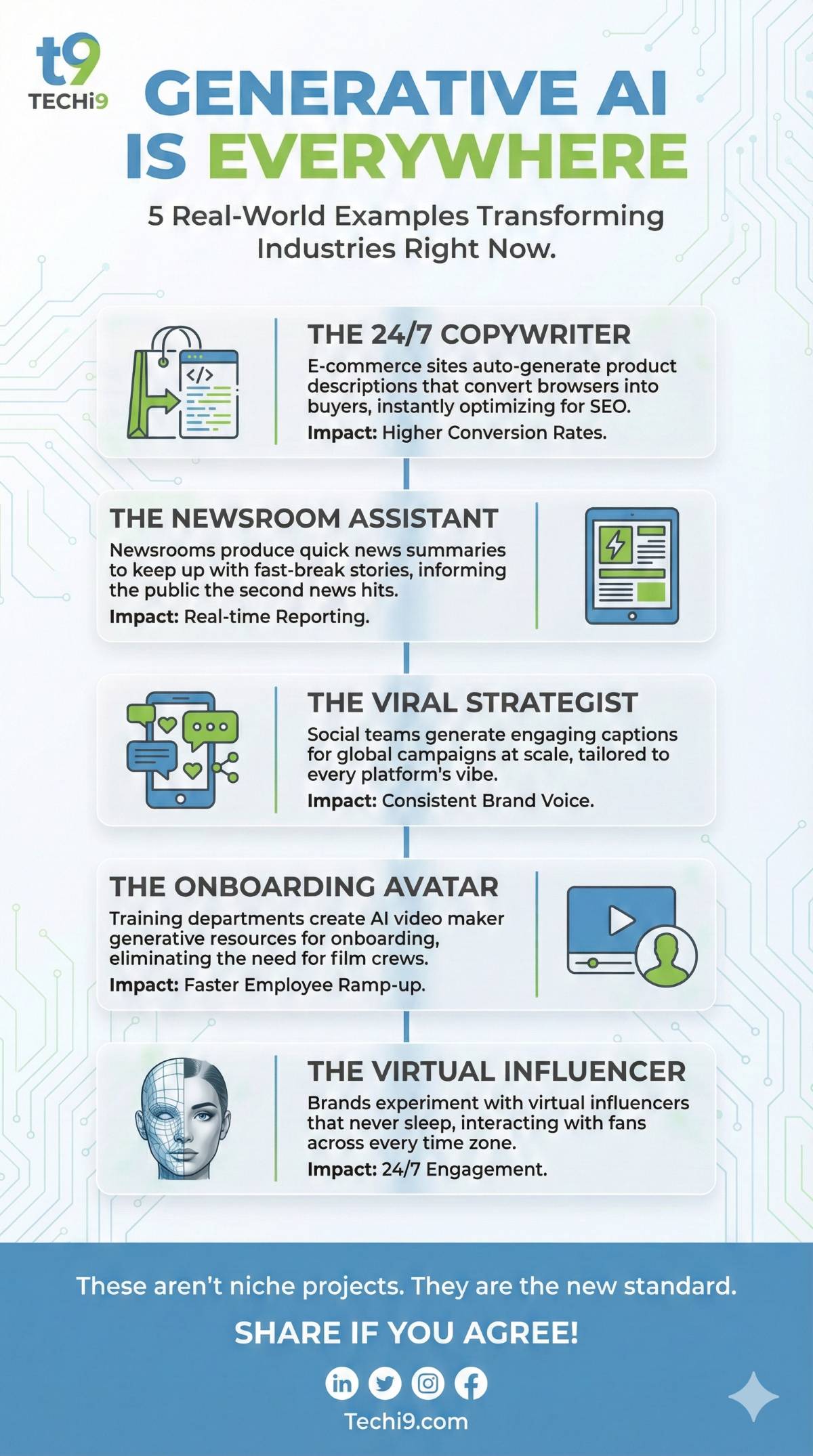
What “generative AI examples” look like
There are plenty of real-world uses of Generative AI content creation across sectors:
- E-commerce sites auto-generate product descriptions that convert
- Newsrooms produce quick news summaries to keep up with fast break stories
- Social teams generate captions for campaigns at scale
- Training departments create AI Video Maker Generative resources for onboarding
- Brands experiment with virtual influencers that never sleep
These aren’t niche projects. They show how this technology blends into everyday marketing, design, and communication workflows.
Putting It Together: Tools You’ll See in 2026
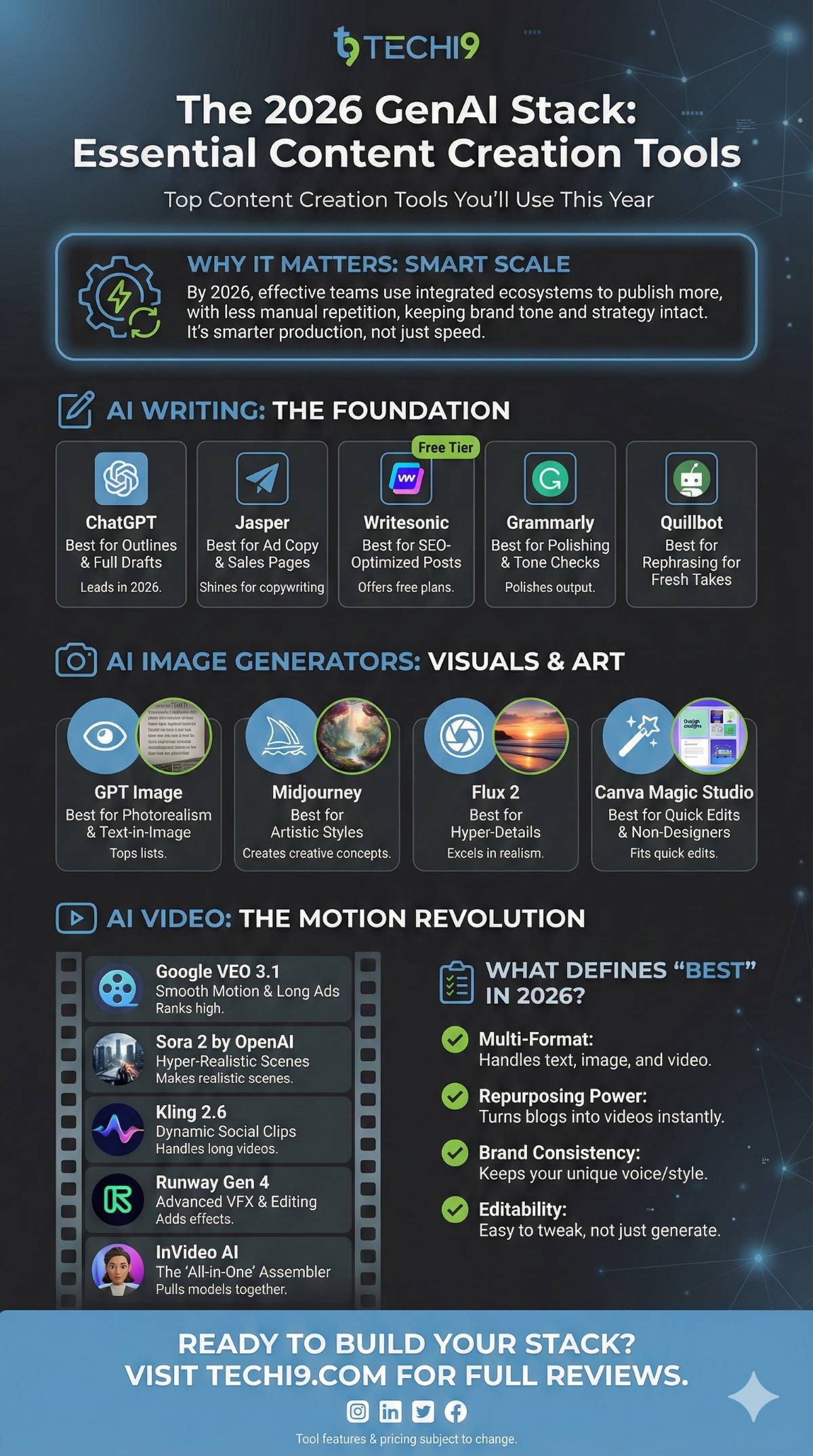
By 2026, the most effective teams will use a stack of AI Content Creator Software and Generative AI marketing tools that cover text, visuals, and video. The best platforms combine:
- SEO-aware AI writing tools
- Fast AI image generator engines
- Intuitive AI video maker generative
- Built-in workflows for content automation
This ecosystem lets creators publish more, with less manual repetition, while keeping tone, brand, and strategy intact. It’s not just speed for speed’s sake; it’s smarter production that helps teams scale without stretching human bandwidth.
Best AI Writing Tools
AI writing tools craft posts, emails, and scripts. ChatGPT leads in 2026. It makes outlines and full drafts. Jasper shines for AI copywriting. Use it for ads and sales pages. Writesonic offers free plans for starters. Grammarly polishes output. Meanwhile, Quillbot rephrases for fresh takes.
| Tool | Key Feature | Best For | Price Start |
| ChatGPT | Outlines & drafts | Bloggers | Free tier |
| Jasper | AI copywriting | Marketers | $59/mo |
| Writesonic | SEO posts | Freelancers | Free tier |
| Grammarly | Editing | All | $12/mo |
These AI Content Generation Tools handle automated content well.
Top AI Image Generator Picks
AI image generator tools make visuals from text. GPT Image tops lists in 2026. It nails text in pics and realism.
Midjourney creates art styles. Flux 2 excels in details. For example, describe a sunset, get pro shots. Canva Magic Studio fits quick edits. Synthetic media like this saves designers time.
| Tool | Strength | Use Case | Access |
| GPT Image | Photorealism | Marketing | ChatGPT |
| Midjourney | Art styles | Creatives | Discord |
| Flux 2 | Details | Social | API |
| Canva | Easy edits | Beginners | Free |
AI video maker generative turn scripts into clips. Google VEO 3.1 ranks high for smooth motion. Sora 2 by OpenAI makes realistic scenes. Kling 2.6 handles long videos. Runway Gen 4 adds effects.
InVideo AI pulls models together. For generative ai examples, see avatars in demos.
| Tool | Top Feature | Length Limit | Best Use |
| VEO 3.1 | Motion | Long | Ads |
| Sora 2 | Realism | Short | Stories |
| Kling 2.6 | Dynamics | Medium | Social |
| Runway | Effects | Varies | Pros |
Best Generative ai tools for content creation 2026 (research-backed)
What “best” actually means in 2026
The strongest tools usually do these well:
- Create content across formats (text, image, video)
- Help you repurpose faster (blog → short video, long post → socials)
- Keep outputs consistent (tone, style, messaging)
- Make editing easy (not just generating)
The Top Picks (and what each is best at)
1) ChatGPT: All-rounder
If you want one tool that can handle strategy + writing + ideation + rewriting + visuals, ChatGPT is still the most flexible “do-it-all” option. OpenAI has continued improving image generation inside ChatGPT, including more precise edits and faster output, which matters a lot for modern content workflows.
Best for:
- Blog outlines, scripts, emails, landing page copy
- Repurposing (blog → LinkedIn post → video script)
- Supporting SEO and Generative AI content creation workflows (structure, FAQs, intent-based sections)
2) Descript: Video Editing That Feels Like Google Docs
Descript is popular because it lets you edit audio/video by editing text. It’s built for creators who hate timeline editing and want speed.
Best for:
- Podcasts + talking head editing
- Cutting filler words, fast revisions, captions
- “Edit video like text” workflow
3) Pictory: Turn Blogs into Videos Fast
Pictory is widely mentioned in 2026 “best tools” lists because it’s built for repurposing written content into short clips quickly (blog/URL/script → video).
Best for:
- Blog-to-video and URL-to-video repurposing
- Quick branded clips for social
- Lightweight workflow for non-editors
4) Empler: Team Workflows + Automation (especially GTM)
For teams, Empler positions itself more as an “agentic” platform that helps execute go-to-market tasks through structured workflows, including content generation. It’s less “a writer tool” and more “multi-step automation + content.”
Best for:
- Teams that want repeatable content workflows
- AI-assisted GTM execution (sales/marketing ops style)
- Central workspace with knowledge + agents
5) Canva: Visuals Quickly (beginner-friendly)
Canva keeps winning for one simple reason: you can go from idea → design → publish without switching tools. Their AI assistant and Magic Studio-style features are built for speed and simplicity.
Best for:
- Social posts, presentations, simple brand creatives
- Fast iterations and templates
- Non-designers who still want clean output
6) InVideo: Video Creation Without Pain
InVideo is frequently recommended because it’s beginner-friendly and template-heavy, and it’s leans into text-to-video style creation. There’s also been notable industry movement around InVideo’s AI-powered video creation capabilities.
Best for:
- Marketing clips, explainers, short-form content
- Quick video generation from prompts/templates
7) Jasper: “Copy Pro” + Brand Controls for Marketing Teams
Jasper keeps showing up in competitor comparisons because it focuses on marketing output at scale and emphasizes brand controls like Brand Voice (so teams don’t sound like 12 different people).
Best for:
- Marketing teams are producing lots of copy
- Brand voice consistency across campaigns
Why These Tools “Beat Rivals” in 2026
They tend to win on:
- Speed: faster drafts, faster editing, faster repurposing
- Quality control: brand voice, templates, structured workflows
- Multi-format creation: writing + visuals + video in one flow
Role of Content Automation in AI Creation
What it means
Content automation is the process of creating, scheduling, and publishing content with minimal manual effort using AI systems. It removes repetitive work from daily content operations.
Why it matters
With Generative AI content creation, automation helps teams:
- Generate first drafts quickly
- Repurpose one piece of content into many formats
- Optimize headlines for clicks and search
- Schedule posts across platforms
This shift allows humans to spend less time pushing content out and more time thinking about strategy, storytelling, and performance.
Understanding Synthetic Media
What it is
Synthetic media refers to images, videos, and audio created entirely or partially by AI. It is one of the most visible outcomes of Generative AI content creation today.
What it includes
- AI avatars for brand videos
- Deepfake-style visuals used in controlled environments
- Narration or training of voice-cloning
Synthetic media is a productive tool that does not enhance mistrust or unethical behavior when applied appropriately.
Benefits of Generative AI content creation
At its core, Generative AI content creation helps teams move faster without losing control. It reduces manual effort while making content production more predictable and manageable.
Why teams rely on it
- Faster production with shorter turnaround times
- Lower costs by reducing dependency on large content teams
- Scalable workflows across blogs, ads, emails, and social platforms
- Consistent quality and tone across high-volume output
- Better personalization using audience and performance data
- Easier content repurposing across formats and channels
- Improved idea generation when teams hit creative blocks
- Support for global teams through quick localization
AI can be used to an advantage and therefore act as a multiplier of productivity, instead of an alternative to human creativity.
Limitations You Must Know
Despite its strengths,Generative AI content creation still requires human judgment to avoid quality and trust issues.
Common challenges
- Factual errors that sound confident but may be incorrect
- Repetitive phrasing when prompts lack clarity
- Limited understanding of real-world nuance or emotion
- Bias inherited from training data
- Over-generic outputs if brand voice is not defined
- Weak storytelling without human direction
- Compliance and ethical risks if left unchecked
That is why review and editing are essential. AI accelerates the work, but humans ensure relevance, accuracy, and authenticity before anything goes live.
SEO and Generative AI Content Creation
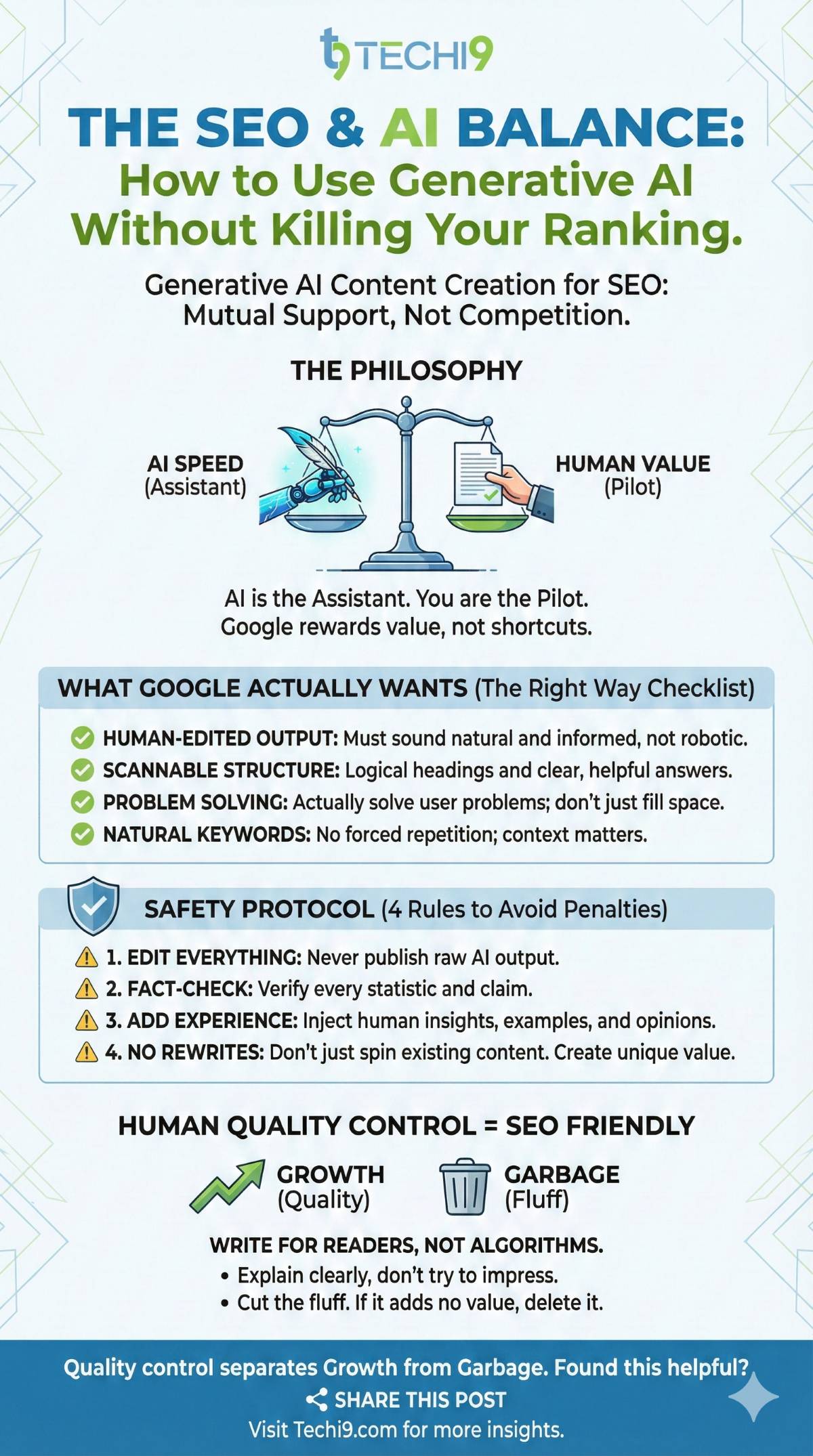
SEO and Generative AI content creation , when the two are in mutual support rather than being competitive. AI is capable of accelerating things, yet search engines are concerned with one thing more than another, value to actual people.
Generative AI can be useful in research, outlining, ideating, and writing used wisely. When handled badly, it produces shallow, commercial content that is today and gone tomorrow.
The difference is not the tool. It’s how you use it.
How AI Supports SEO When Used the Right Way
AI supports SEO when it is treated like an assistant, not a replacement.
Top-performing content across Google shows a clear pattern. AI helps behind the scenes, while humans stay in control of the final output.
Strong SEO and Generative AI content creation focuses on:
- Human-edited output that sounds natural and informed
- Clear structure with logical headings and scannable sections
- Helpful answers that actually solve user problems
- Natural keyword usage instead of forced repetition
Google does not reward shortcuts. It rewards clarity, usefulness, and credibility. AI can assist you to get there quicker, yet it cannot simulate human experience.
How to Use Generative AI Content Creation Safely
To ensure that AI-generated content works well and does not suffer punishment, you must abide by these rules that cannot be compromised.
Core Rules to Follow
- Never publish raw output without editing
- Fact-check everything, especially statistics and claims
- Uses human insights, examples, and opinions.
- To prevent plagiarism, do not plagiarize, rewrite, or restructure.
This strategy will make your content credible, unique, and in line with search engine policies. It similarly creates a long-term authority rather than a burst of traffic.
Human Content Is SEO Friendly AI Content
The top-ranked articles always demonstrate the same thing: AI-assisted works are best when their content is written by someone who knows what they are talking about.
That means:
- Writing for readers, not algorithms
- Explaining concepts clearly, not impressively
- Using keywords where they make sense
- Cutting fluff instead of adding it
In SEO and Generative AI content creation, quality control is what separates growth from garbage.
The Future of Generative AI Content Creation
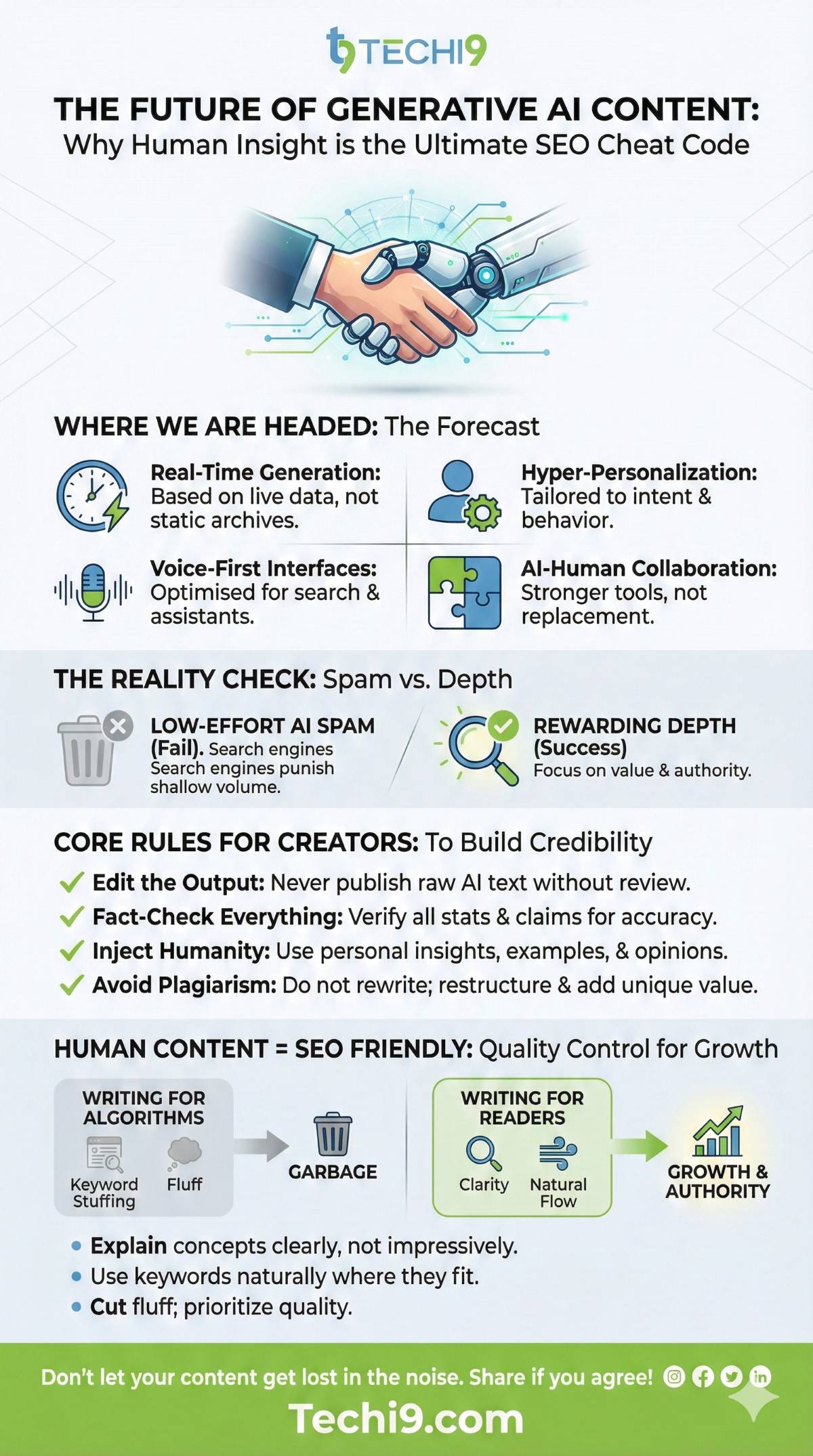
The direction is clear, and serious marketers already see it coming.
The future will bring:
- Real-time content generation based on live data
- Better personalization for user intent and behaviour
- Voice-first interfaces optimised for search and assistants
- Stronger AI-human collaboration, not replacement
At the same time, low-effort AI spam will continue to fail. Search engines are evolving fast, and they are getting better at rewarding depth over volume.
FAQs:
- What are the top 3 generative AI tools?OpenAI ChatGPT
Jasper
Copy.aiAdd Image - What is generative AI tools?Generative AI tools are software applications that use algorithms to create content, such as text, images, music, and more, based on input data.Add Image
- Which are the top 5 AI tools?Jasper
Grammarly
Surfer SEO
ChatGPT
Copy.ai Add Image - Is ChatGPT a generative AI?Yes.Add Image
- What are some generative AI examples in marketing?Generative AI examples include personalized ads and emails. Tools like HubSpot use them for engagement.Add Image
Add New FAQ
Conclusion
generative-ai-tools has transformed content planning, creation, and scaling. It facilitates the ability of teams to work more rapidly, remain steady, and create content through the use of text, pictures, and video without over-exerting themselves.
Nonetheless, everything is a matter of smart tool usage. The burden of work can be transferred to AI, and the direction to take is outlined by humans, which makes content effective and useful.
Call to Action
Ready to use Generative AI content creation the right way? Start by testing one AI writing, image, or video tool this week. Track what saves time. Improve what needs a human touch. Scale only what works. The future of content is already here. Use it with intent.
- Social media graphics
- Blog visuals
- Ad creatives
- Product mockups
This form of synthetic media saves designers hours. Renowned ones are Midjourney and DALL*E.
AI Video Maker Generative
An AI video maker generative turns text or images into videos. Some even generate avatars and voiceovers.
They are widely used for:
- YouTube videos
- Reels and Shorts
- Training videos
- Product demos
Tools like Runway and Pictory lead this space.
AI Content Generation Tools
AI content generation tools are platforms that combine writing, image, and video generation.
These tools often include:
- Templates
- Brand tone settings
- SEO optimization
- Workflow automation
As a result, teams produce more content with fewer resources.
AI Content Creator Software for Businesses
AI content creator software helps brands manage content end-to-end.
Key features include:
- Multi-format creation
- Team collaboration
- Publishing workflows
- Analytics integration
Such platforms support automated content strategies without chaos.
Generative AI Tools for Marketing
Generative AI Marketing Tools focus on performance-driven content.
They help with:
- Ad variations
- Email personalization
- Landing page copy
- Social captions
For example, marketers use generative ai examples like dynamic product descriptions based on user behavior.
Therefore, conversion rates improve without extra effort.
AI Writing Tools: A Deep Dive
What they are
AI writing tools are software powered by Generative AI content creation that help produce written content faster while keeping quality high. They’re not just for short blurbs anymore; today’s tools handle long-form content that can compete in SEO.
How they help
Professional creators use these tools to build:
- Keyword integration that aligns text with search intent
- Content outlines that give structure before writing
- Readability improvement so the content flows better
- Tone control to match brand voice
This is where AI content generation tools start to show real value. They speed up drafting and shape ideas, but human editors still add accuracy, nuance, and judgment. In other words, AI copywriting accelerates work, and humans refine it.
AI Image Generator Use Cases
What it is
An AI image generator uses Generative AI content creation principles to create custom visuals based on your input. It goes beyond generic stock images to produce something tailored and on-brand.
Where it shines
Creators are using these tools for:
- Custom blog visuals that support written content
- Branded social posts with unique style
- Concept art for storytelling or mood boards
- Thumbnails for videos that attract clicks
These images improve engagement because they’re original and contextually relevant. As synthetic media, they help your work stand out rather than look like everyone else’s.
AI Video Maker Generative for Short-Form Content
What it is
An AI video maker is software that automatically creates or edits video clips using machine learning. It’s a subset of automated content that lets you produce videos without expensive gear or long editing cycles.
Where it works best
Short-form platforms are a perfect fit:
- Instagram Reels that grab quick attention
- YouTube Shorts that build audience fast
- LinkedIn videos that boost professional reach
Creators using these tools can post new videos daily without burning out. That pace matters in a world where attention moves fast and fresh content wins.
Generative AI Examples Across Industries
What “generative AI examples” look like
There are plenty of real-world uses of Generative AI content creation across sectors:
- E-commerce sites auto-generate product descriptions that convert
- Newsrooms produce quick news summaries to keep up with fast break stories
- Social teams generate captions for campaigns at scale
- Training departments create AI video maker generative resources for onboarding
- Brands experiment with virtual influencers that never sleep
These aren’t niche projects. They show how this technology blends into everyday marketing, design, and communication workflows.
Putting It Together: Tools You’ll See in 2026
By 2026, the most effective teams will use a stack of AI content creator software and Generative AI marketing tools that cover text, visuals, and video. The best platforms combine:
- SEO-aware AI writing tools
- Fast AI image generator engines
- Intuitive AI video maker generative
- Built-in workflows for content automation
This ecosystem lets creators publish more, with less manual repetition, while keeping tone, brand, and strategy intact. It’s not just speed for speed’s sake; it’s smarter production that helps teams scale without stretching human bandwidth.
Best AI Writing Tools
AI writing tools craft posts, emails, and scripts. ChatGPT leads in 2026. It makes outlines and full drafts. Jasper shines for AI copywriting. Use it for ads and sales pages. Writesonic offers free plans for starters. Grammarly polishes output. Meanwhile, Quillbot rephrases for fresh takes.
| Tool | Key Feature | Best For | Price Start |
| ChatGPT | Outlines & drafts | Bloggers | Free tier |
| Jasper | AI copywriting | Marketers | $59/mo |
| Writesonic | SEO posts | Freelancers | Free tier |
| Grammarly | Editing | All | $12/mo |
These AI content generation tools handle automated content well.
Top AI Image Generator Picks
AI image generator tools make visuals from text. GPT Image tops lists in 2026. It nails text in pics and realism.
Midjourney creates art styles. Flux 2 excels in details. For example, describe a sunset, get pro shots. Canva Magic Studio fits quick edits. Synthetic media like this saves designers time.
| Tool | Strength | Use Case | Access |
| GPT Image | Photorealism | Marketing | ChatGPT |
| Midjourney | Art styles | Creatives | Discord |
| Flux 2 | Details | Social | API |
| Canva | Easy edits | Beginners | Free |
AI video maker generative turn scripts into clips. Google VEO 3.1 ranks high for smooth motion. Sora 2 by OpenAI makes realistic scenes. Kling 2.6 handles long videos. Runway Gen 4 adds effects.
InVideo AI pulls models together. For generative ai examples, see avatars in demos.
| Tool | Top Feature | Length Limit | Best Use |
| VEO 3.1 | Motion | Long | Ads |
| Sora 2 | Realism | Short | Stories |
| Kling 2.6 | Dynamics | Medium | Social |
| Runway | Effects | Varies | Pros |
Best Generative ai tools for content creation 2026 (research-backed)
What “best” actually means in 2026
The strongest tools usually do these well:
- Create content across formats (text, image, video)
- Help you repurpose faster (blog → short video, long post → socials)
- Keep outputs consistent (tone, style, messaging)
- Make editing easy (not just generating)
The Top Picks (and what each is best at)
1) ChatGPT: All-rounder
If you want one tool that can handle strategy + writing + ideation + rewriting + visuals, ChatGPT is still the most flexible “do-it-all” option. OpenAI has continued improving image generation inside ChatGPT, including more precise edits and faster output, which matters a lot for modern content workflows.
Best for:
- Blog outlines, scripts, emails, landing page copy
- Repurposing (blog → LinkedIn post → video script)
- Supporting SEO and Generative AI content creation workflows (structure, FAQs, intent-based sections)
2) Descript: Video Editing That Feels Like Google Docs
Descript is popular because it lets you edit audio/video by editing text. It’s built for creators who hate timeline editing and want speed.
Best for:
- Podcasts + talking head editing
- Cutting filler words, fast revisions, captions
- “Edit video like text” workflow
3) Pictory: Turn Blogs into Videos Fast
Pictory is widely mentioned in 2026 “best tools” lists because it’s built for repurposing written content into short clips quickly (blog/URL/script → video).
Best for:
- Blog-to-video and URL-to-video repurposing
- Quick branded clips for social
- Lightweight workflow for non-editors
4) Empler: Team Workflows + Automation (especially GTM)
For teams, Empler positions itself more as an “agentic” platform that helps execute go-to-market tasks through structured workflows, including content generation. It’s less “a writer tool” and more “multi-step automation + content.”
Best for:
- Teams that want repeatable content workflows
- AI-assisted GTM execution (sales/marketing ops style)
- Central workspace with knowledge + agents
5) Canva: Visuals Quickly (beginner-friendly)
Canva keeps winning for one simple reason: you can go from idea → design → publish without switching tools. Their AI assistant and Magic Studio-style features are built for speed and simplicity.
Best for:
- Social posts, presentations, simple brand creatives
- Fast iterations and templates
- Non-designers who still want clean output
6) InVideo: Video Creation Without Pain
InVideo is frequently recommended because it’s beginner-friendly and template-heavy, and it’s leans into text-to-video style creation. There’s also been notable industry movement around InVideo’s AI-powered video creation capabilities.
Best for:
- Marketing clips, explainers, short-form content
- Quick video generation from prompts/templates
7) Jasper: “Copy Pro” + Brand Controls for Marketing Teams
Jasper keeps showing up in competitor comparisons because it focuses on marketing output at scale and emphasizes brand controls like Brand Voice (so teams don’t sound like 12 different people).
Best for:
- Marketing teams are producing lots of copy
- Brand voice consistency across campaigns
Why These Tools “Beat Rivals” in 2026
They tend to win on:
- Speed: faster drafts, faster editing, faster repurposing
- Quality control: brand voice, templates, structured workflows
- Multi-format creation: writing + visuals + video in one flow
Role of Content Automation in AI Creation
What it means
Content automation is the process of creating, scheduling, and publishing content with minimal manual effort using AI systems. It removes repetitive work from daily content operations.
Why it matters
With Generative AI content creation, automation helps teams:
- Generate first drafts quickly
- Repurpose one piece of content into many formats
- Optimize headlines for clicks and search
- Schedule posts across platforms
This shift allows humans to spend less time pushing content out and more time thinking about strategy, storytelling, and performance.
Understanding Synthetic Media
What it is
Synthetic media refers to images, videos, and audio created entirely or partially by AI. It is one of the most visible outcomes of Generative AI content creation today.
What it includes
- AI avatars for brand videos
- Deepfake-style visuals used in controlled environments
- Narration or training of voice-cloning
Synthetic media is a productive tool that does not enhance mistrust or unethical behavior when applied appropriately.
Benefits of Generative AI content creation
At its core, Generative AI content creation helps teams move faster without losing control. It reduces manual effort while making content production more predictable and manageable.
Why teams rely on it
- Faster production with shorter turnaround times
- Lower costs by reducing dependency on large content teams
- Scalable workflows across blogs, ads, emails, and social platforms
- Consistent quality and tone across high-volume output
- Better personalization using audience and performance data
- Easier content repurposing across formats and channels
- Improved idea generation when teams hit creative blocks
- Support for global teams through quick localization
AI can be used to an advantage and therefore act as a multiplier of productivity, instead of an alternative to human creativity.
Limitations You Must Know
Despite its strengths, Generative AI content creation still requires human judgment to avoid quality and trust issues.
Common challenges
- Factual errors that sound confident but may be incorrect
- Repetitive phrasing when prompts lack clarity
- Limited understanding of real-world nuance or emotion
- Bias inherited from training data
- Over-generic outputs if brand voice is not defined
- Weak storytelling without human direction
- Compliance and ethical risks if left unchecked
That is why review and editing are essential. AI accelerates the work, but humans ensure relevance, accuracy, and authenticity before anything goes live.
SEO and Generative AI Content Creation
SEO and Generative AI content creation , when the two are in mutual support rather than being competitive. AI is capable of accelerating things, yet search engines are concerned with one thing more than another, value to actual people.
Generative AI can be useful in research, outlining, ideating, and writing used wisely. When handled badly, it produces shallow, commercial content that is today and gone tomorrow.
The difference is not the tool. It’s how you use it.
How AI Supports SEO When Used the Right Way
AI supports SEO when it is treated like an assistant, not a replacement.
Top-performing content across Google shows a clear pattern. AI helps behind the scenes, while humans stay in control of the final output.
Strong SEO and Generative AI content creation focuses on:
- Human-edited output that sounds natural and informed
- Clear structure with logical headings and scannable sections
- Helpful answers that actually solve user problems
- Natural keyword usage instead of forced repetition
Google does not reward shortcuts. It rewards clarity, usefulness, and credibility. AI can assist you to get there quicker, yet it cannot simulate human experience.
How to Use Generative AI Content Creation Safely
To ensure that AI-generated content works well and does not suffer punishment, you must abide by these rules that cannot be compromised.
Core Rules to Follow
- Never publish raw output without editing
- Fact-check everything, especially statistics and claims
- Uses human insights, examples, and opinions.
- To prevent plagiarism, do not plagiarize, rewrite, or restructure.
This strategy will make your content credible, unique, and in line with search engine policies. It similarly creates a long-term authority rather than a burst of traffic.
Human Content Is SEO Friendly AI Content
The top-ranked articles always demonstrate the same thing: AI-assisted works are best when their content is written by someone who knows what they are talking about.
That means:
- Writing for readers, not algorithms
- Explaining concepts clearly, not impressively
- Using keywords where they make sense
- Cutting fluff instead of adding it
In SEO and Generative AI content creation, quality control is what separates growth from garbage.
The Future of Generative AI Content Creation
The direction is clear, and serious marketers already see it coming.
The future will bring:
- Real-time content generation based on live data
- Better personalization for user intent and behaviour
- Voice-first interfaces optimised for search and assistants
- Stronger AI-human collaboration, not replacement
At the same time, low-effort AI spam will continue to fail. Search engines are evolving fast, and they are getting better at rewarding depth over volume.
FAQs:
What are the top 3 generative AI tools?
OpenAI ChatGPT
Jasper
Copy.ai
What is generative AI tools?
Generative AI tools are software applications that use algorithms to create content, such as text, images, music, and more, based on input data.
Which are the top 5 AI tools?
Jasper
Grammarly
Surfer SEO
ChatGPT
Copy.ai
Is ChatGPT a generative AI?
Yes.
What are some generative AI examples in marketing?
Generative AI examples include personalized ads and emails. Tools like HubSpot use them for engagement.
Conclusion
generative-ai-tools has transformed content planning, creation, and scaling. It facilitates the ability of teams to work more rapidly, remain steady, and create content through the use of text, pictures, and video without over-exerting themselves.
Nonetheless, everything is a matter of smart tool usage. The burden of work can be transferred to AI, and the direction to take is outlined by humans, which makes content effective and useful.
Call to Action
Ready to use Generative AI content creation the right way? Start by testing one AI writing, image, or video tool this week. Track what saves time. Improve what needs a human touch. Scale only what works. The future of content is already here. Use it with intent.